🌊 Waves & Oscillations · 26 March 2026
The Doppler Effect
In 1842, Austrian physicist Christian Doppler described a phenomenon that anyone who has heard an ambulance siren knows intuitively: the pitch of a sound changes depending on whether the source is moving toward or away from you. This apparent change in frequency (or wavelength) due to relative motion between source and observer is now called the Doppler Effect.
How It Works
When a sound source moves toward you, each successive wavefront is emitted from a position slightly closer. The wavefronts compress together, shortening the wavelength and raising the perceived frequency (higher pitch). When the source moves away, the opposite happens — wavefronts stretch apart, lowering the frequency (lower pitch).
The observed frequency is given by:
where the minus sign applies when the source approaches (frequency increases) and the plus sign when it recedes (frequency decreases).
| Scenario | Observed Frequency | Observed Wavelength |
|---|---|---|
| Source approaching | Higher | Shorter |
| Source stationary | Unchanged | Unchanged |
| Source receding | Lower | Longer |
| Source at wave speed | Infinite (sonic boom) | Zero (shock wave) |
Light: Red Shift and Blue Shift
The Doppler effect applies to all waves, including light. When a star or galaxy moves toward us, its light is compressed to shorter wavelengths — shifted toward the blue end of the spectrum (blue shift). When it moves away, the light shifts toward red (red shift).
This simple relationship is the foundation of modern observational cosmology. Edwin Hubble's discovery that distant galaxies are redshifted led to the realization that the universe is expanding.
Wavefront Controls
Spectrum Controls
Things to Try
- Increase source speed from 0 to 330 m/s — watch the wavefronts compress in front of the source and stretch behind it.
- Source speed = wave speed (343 m/s) — the wavefronts pile up into a shock wave (sonic boom). The formula gives an infinite observed frequency.
- Vary the frequency — higher frequencies show more dramatic compression of the wavefronts.
- Adjust the spectrum velocity slider — watch the emission line shift from its rest position toward blue (approaching) and red (receding).
- Compare the readout panel — note how and change asymmetrically as speed increases.
Real-World Applications
- Police radar guns emit radio waves at a known frequency. The reflected wave from a moving car is Doppler-shifted, and the speed is calculated from the frequency difference. The underlying principle relates to wave speed, frequency, and wavelength.

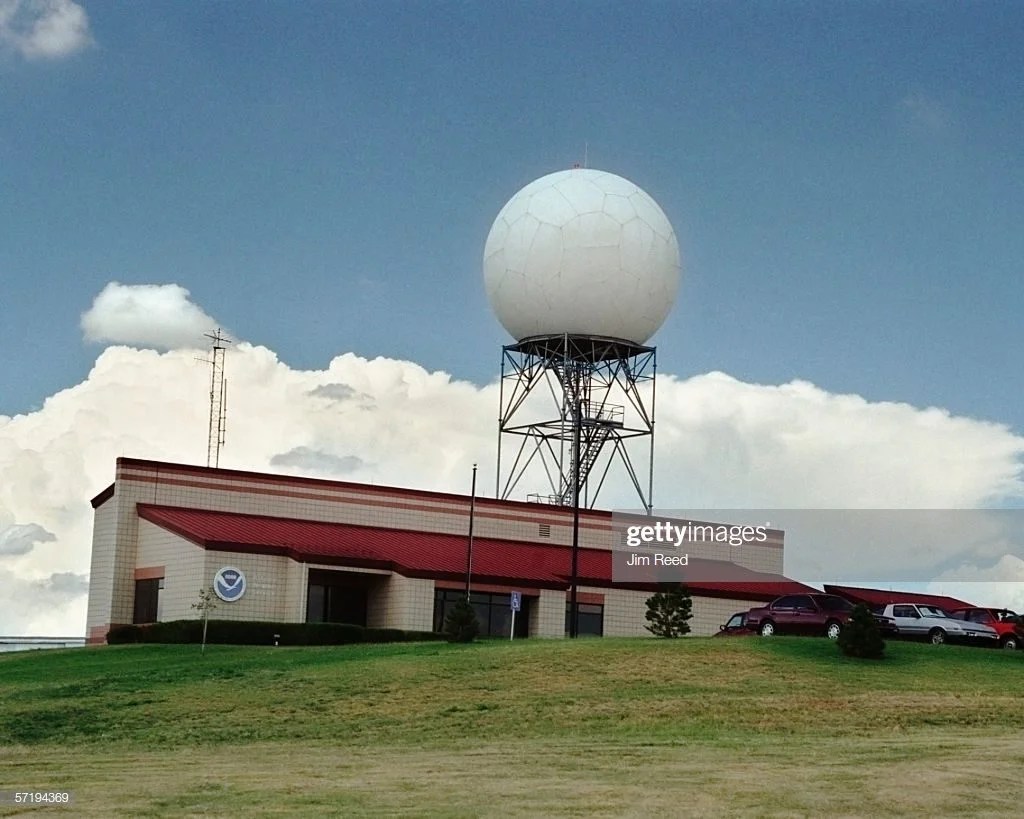
- Doppler weather radar measures the velocity of rain droplets and cloud formations by analyzing the frequency shift of reflected microwave pulses. This enables meteorologists to detect rotation inside thunderstorms (tornado signatures).
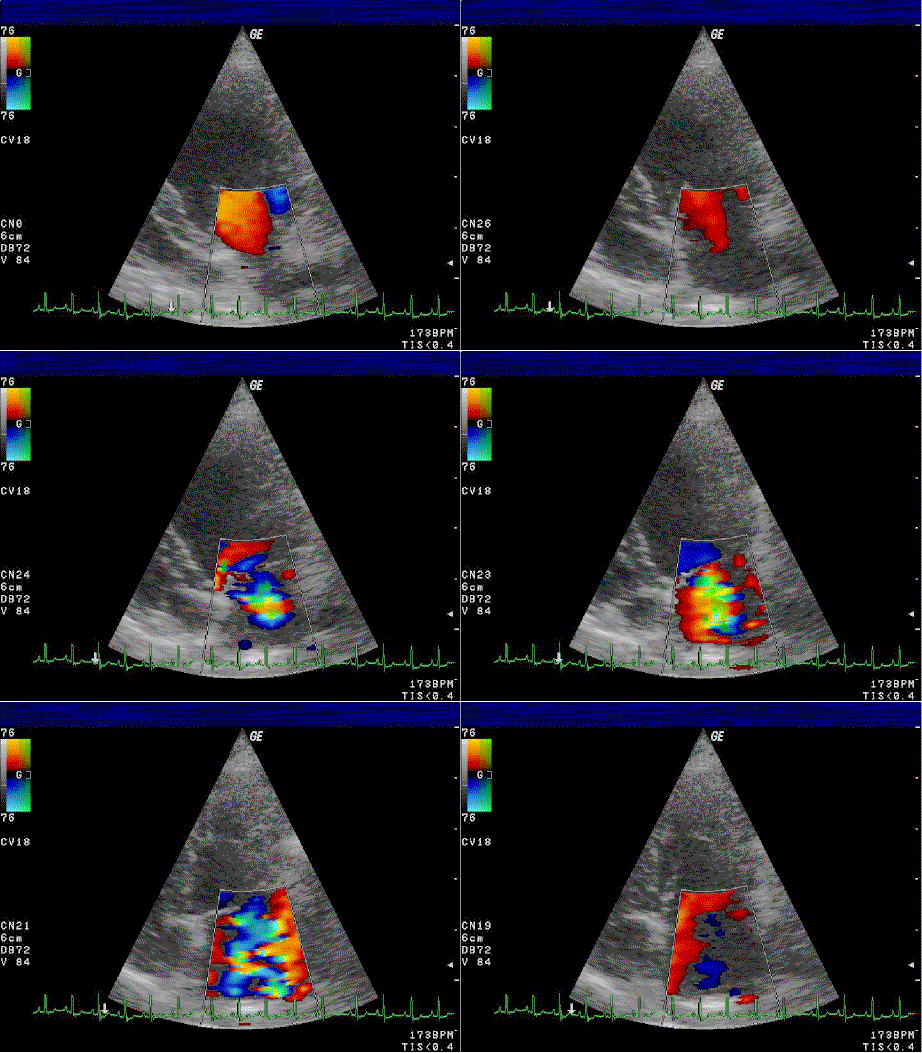
- Medical echocardiography uses ultrasound waves reflected off moving blood cells. The Doppler shift reveals blood flow speed and direction, helping diagnose heart valve problems.
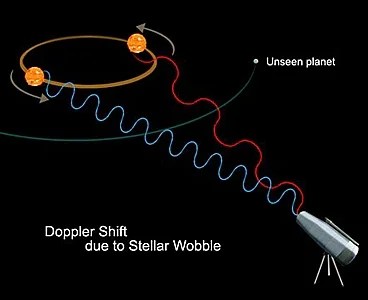
- Exoplanet detection (radial velocity method): A planet orbiting a star causes the star to wobble slightly. This wobble produces a periodic Doppler shift in the star's spectral lines, revealing the planet's mass and orbital period — even when the planet is invisible.
Beyond classical Doppler — At relativistic speeds (significant fraction of ), the classical formula breaks down. Special relativity gives the relativistic Doppler effect, which includes a transverse component: even a source moving perpendicular to the line of sight shows a frequency shift due to time dilation.
Explore more simulations
Every concept on PhysicStuff has an interactive simulation. No login, no setup required.