🔬 Optics · 7 May 2018
What is a Mirage?
On a hot summer day, glance down a straight highway and you may see what looks like a pool of shimmering water on the road ahead — water that vanishes as you approach. This is an inferior mirage, and it's one of the most common optical phenomena in nature. But mirages are not hallucinations: they are real optical images, formed by genuine bending of light rays, and a camera captures them just as your eyes do.
Light in a Uniform Medium
In a uniform medium — air at constant temperature — light travels in straight lines. This is the simplest optical case. Snell's law governs what happens at a sharp boundary between two media with different refractive indices, and understanding refraction is essential to lens optics:
where is the refractive index and is the angle measured from the normal (perpendicular) to the boundary. A higher refractive index means light travels more slowly and bends toward the normal.
Air's refractive index is close to 1.000, but not exactly — and it depends on density, which depends on temperature. Hot air is less dense than cold air, so it has a slightly lower refractive index. At sea level on a hot day, the refractive index of air can differ by about 0.0001 between the surface and a meter above it — a tiny difference, but enough to noticeably bend light over distances of hundreds of meters.
Gradual Bending: The Real Mechanism
Rather than a single sharp boundary, the atmosphere has a continuous temperature gradient on a hot day. This means there is a continuous gradient of refractive index, and light undergoes continuous refraction — it curves gradually through the medium rather than bending sharply at one point.
From quantum electrodynamics, the underlying principle is Fermat's principle of least time: light takes the path between two points that requires the minimum travel time, even if that path is curved. In a medium where speed varies with position (because varies), the fastest path is often curved — following the region of lower refractive index (higher speed) rather than taking the geometrically shortest straight line.
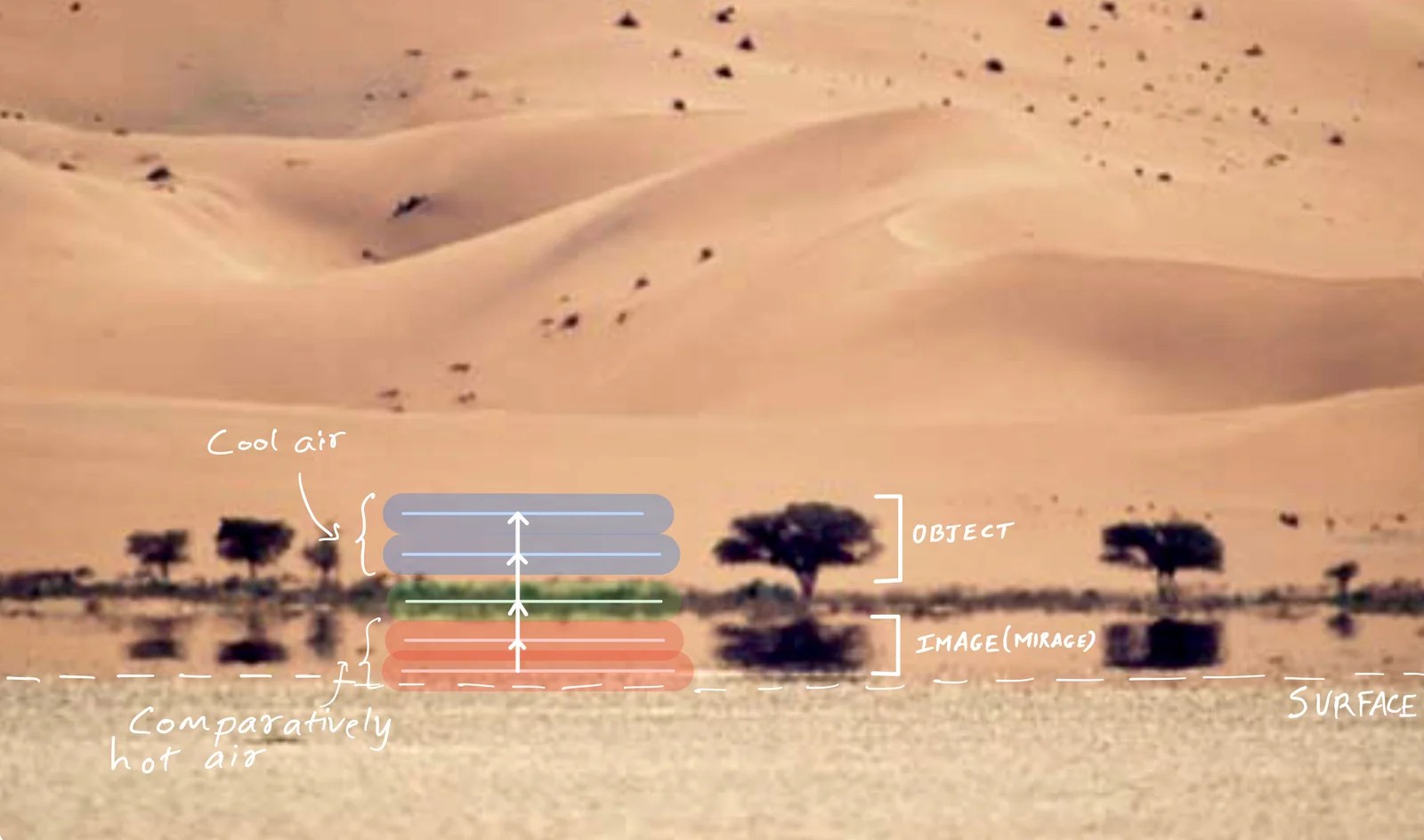
On a hot road, the air near the surface is hottest (lowest , fastest light speed). A ray from the sky, traveling downward at a shallow angle, curves upward as it enters successively hotter, lower- air near the road. If the ray's angle is shallow enough, it eventually curves back upward — effectively reflecting off the hot-air layer.
From your eye, this curved ray appears to come from below the horizon, creating an inverted image of the sky. Your brain interprets a shimmering blue patch below the horizon as water — because that's what a shimmering blue patch below the horizon almost always is.
Types of Mirages
Inferior Mirage
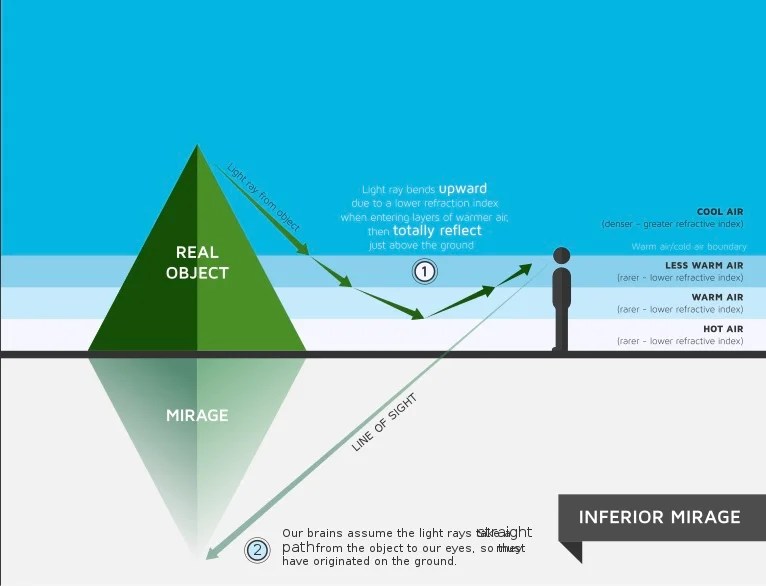
"Inferior" means the image appears below the real object — in this case, below the actual sky. This is the classic highway mirage. It requires:
- A hot surface heating the air layer just above it (road, desert, tarmac)
- The observer at distance (tens to hundreds of meters)
- A line of sight at a very shallow angle to the surface
The image is inverted (the sky appears upside down in the "puddle") and shimmers because the hot air is turbulent — rising convection currents constantly vary the refractive index, making the image dance. As you approach the apparent location of the mirage, the geometry changes — the hot air is now beneath you — and the mirage retreats. You can never reach it.
Superior Mirage
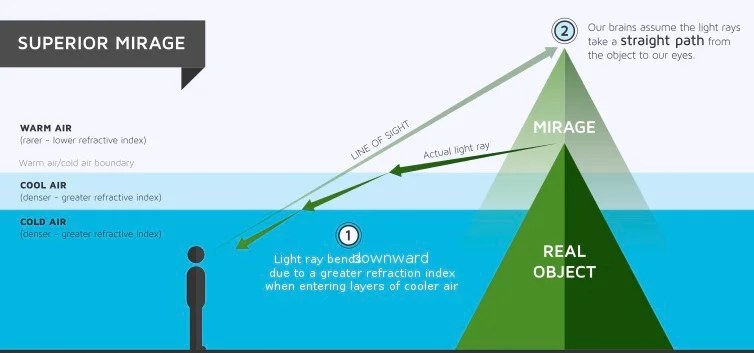
"Superior" means the image appears above the real object. This requires a temperature inversion: cold air near the surface with warmer air above — the opposite of normal. This happens over cold water, ice sheets, and in polar regions.
In a temperature inversion, light from distant objects is bent downward rather than upward, carrying images over the horizon. Superior mirages can reveal ships, coastlines, or even entire islands that are geometrically below the horizon — sometimes by hundreds of kilometers. The phenomenon is stable and can last for hours, unlike inferior mirages.
Superior mirages have been reported by sailors throughout history and may explain some legendary reports of "phantom islands" and ghost ships.
Fata Morgana
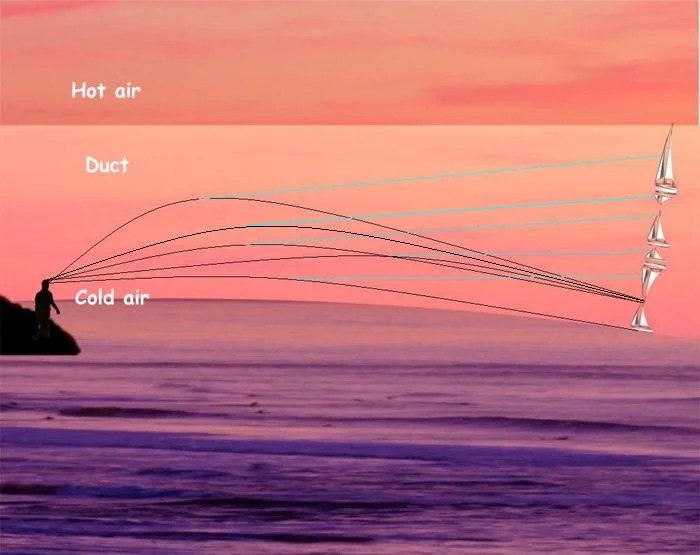
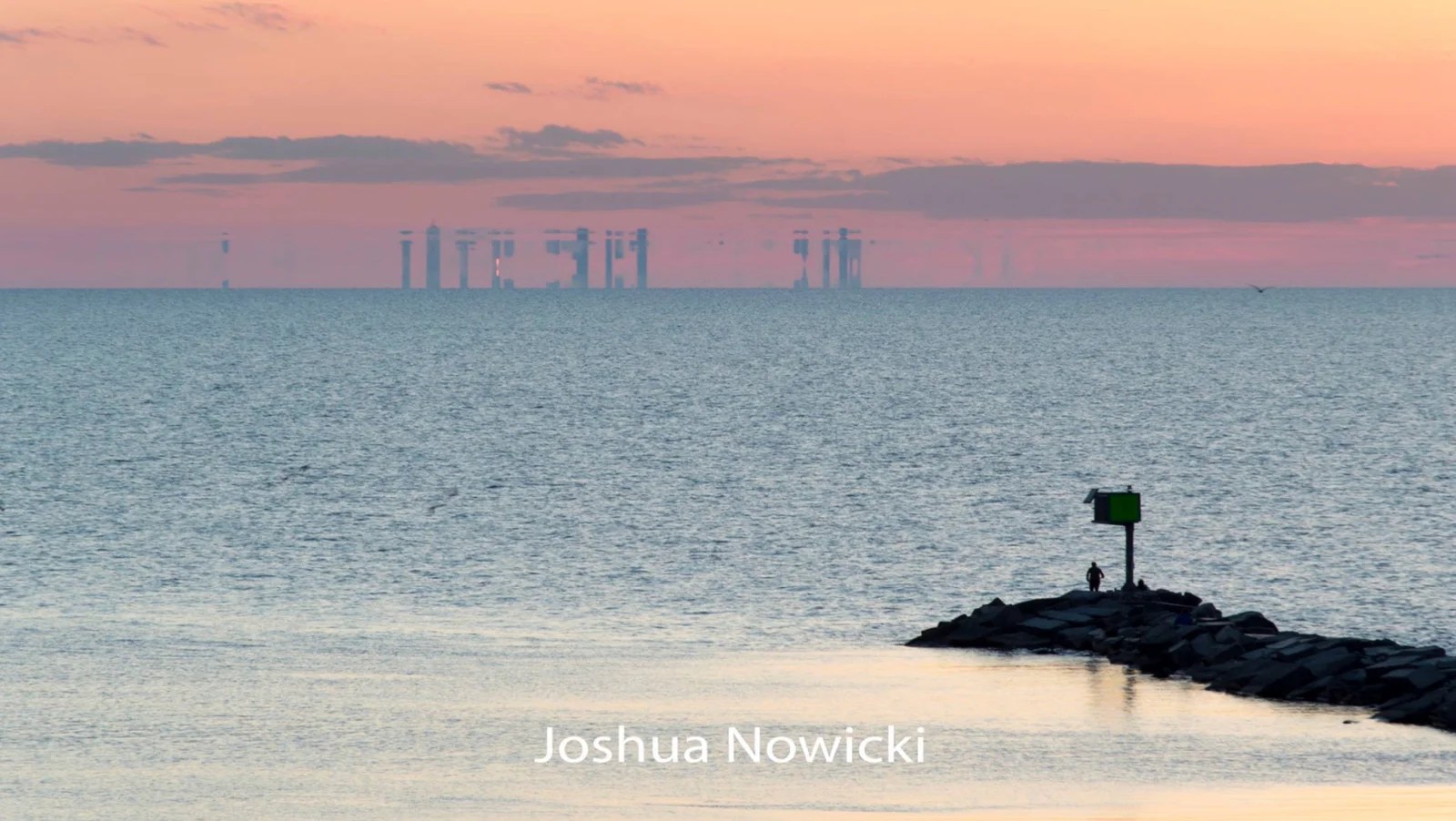
The Fata Morgana is a complex superior mirage in which the atmosphere acts as a lens with multiple layers of refractive index gradients, producing several distorted images — erect and inverted — stacked vertically. The name comes from the Italian for Morgan le Fay, the sorceress in Arthurian legend who was said to lure sailors onto reefs with visions of distant lands.
A Fata Morgana can transform a distant ship into a towering castle, a distant iceberg into a jagged skyline, or a small island into a floating mountain range. The images change rapidly as the atmospheric layers shift, causing objects to appear to stretch, compress, multiply, and distort within seconds.
One famous example: on clear days with the right atmospheric conditions, the Chicago skyline has been photographed from New Buffalo, Michigan — across Lake Michigan, roughly 90 km away — as a floating Fata Morgana image.
The Geometry of Refraction
The degree of bending depends on the lapse rate — how quickly temperature changes with altitude. In a normal atmosphere, temperature decreases with altitude at about 9.8 °C/km (the dry adiabatic lapse rate). Near a very hot surface, the actual temperature gradient can be much steeper — hundreds of degrees per kilometer in the lowest meter — producing sharp, visible mirages.
The critical angle for total internal reflection in optics has a loose analogue here: if a ray's angle to the surface is below a certain threshold (typically less than 1° for atmospheric mirages), it will curve back upward before reaching the surface. Steeper rays are not affected and travel in straight lines.
Mirages in Other Contexts
- Desert mirages (inferior): The classic image of an oasis that isn't there. The same physics as a highway mirage, but over hotter sand.
- Novaya Zemlya effect: A type of superior mirage in polar regions where the Sun appears above the horizon days before it actually rises, due to extreme temperature inversion over cold sea ice.
- Atmospheric ducting: In radio propagation, the same refractive bending that creates visual mirages can also trap radio waves in a horizontal layer, allowing signals to travel far beyond the normal horizon — sometimes thousands of kilometers.
- Green flash: At sunset, the top of the sun's disk is refracted more strongly than the bottom (because the blue/green end of the spectrum is refracted more than red). The very last sliver of the sun seen on the horizon can appear green — a brief flash lasting a second or less, visible under exceptional atmospheric conditions.
Mirages are a perfect demonstration of why physics demands precision language. In everyday speech, "mirage" means "an illusion" — something that isn't real. But physically, a mirage is a real image formed by real refraction of real light. The "illusion" is not the mirage itself but the brain's interpretation of where the light came from. The distinction matters: if you drove to where you saw the mirage puddle and took a photograph looking backward, you would see a mirage in that direction too.
Explore more simulations
Every concept on PhysicStuff has an interactive simulation. No login, no setup required.