🧪 General · 11 November 2017
Why Did We Redefine Mass?
On May 20, 2019 — World Metrology Day — an object sitting in a vault near Paris quietly lost its job as the most important physical artifact in the world. The International Prototype of the Kilogram (IPK), a polished platinum-iridium cylinder that had defined the kilogram since 1889, was retired. The kilogram was redefined not in terms of a physical object, but in terms of a fundamental constant of nature.
This was the culmination of a decades-long effort by the world's metrology community, and the reasons for it reveal something profound about how science defines reality.
The Old Kilogram and Its Fatal Flaw
The IPK was crafted in the 1880s from an alloy of 90% platinum and 10% iridium — chosen for its exceptional density (21.56 g/cm³), hardness, resistance to corrosion and oxidation, and good machinability. Stored under three concentric glass bell jars at the Bureau International des Poids et Mesures (BIPM) in Sèvres, France, it is handled as rarely as possible, cleaned only by specific protocols, and never exposed to contaminating environments.
Six official copies — the "sister kilograms" — were distributed to national metrology laboratories worldwide. Dozens more national copies hold their own standards. Every few decades, these are all brought back to France and compared to the IPK under controlled conditions.
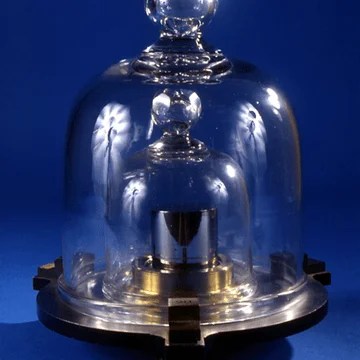
And there is the problem: when you compare the copies to the original, they don't all agree. After the most recent periodic verification in 1988–1992, the IPK and its sisters had drifted apart by up to 50 micrograms — about the mass of a grain of fine sand — over 100 years.
Fifty micrograms sounds trivial. But consider: the kilogram underpins the entire SI system of units. The newton is kg·m/s². The pascal is N/m². The joule is N·m. The watt is J/s. The ampere is defined partly through force between current-carrying wires, which involves newtons, which involves kilograms. If the kilogram drifts, every unit derived from it drifts with it.
Worse: there was no way to determine whether it was the IPK itself that had changed, or the copies, or both. The IPK was the definition — you cannot measure it against itself.
The Solution: Fundamental Constants
The modern SI (since 2019) takes a radically different approach: instead of defining units in terms of physical artifacts, it defines units in terms of fixed numerical values of fundamental constants of nature.
These constants — the speed of light, Planck's constant, the elementary charge, Boltzmann's constant, Avogadro's constant — are the same everywhere in the universe, at all times, for all observers. They cannot be lost, stolen, damaged, or drift over time. Any laboratory on Earth (or in principle, anywhere in the universe) can realize the unit from scratch.
The new kilogram is defined by fixing Planck's constant to the exact value:
Since , and the meter is defined via the speed of light and the second is defined via the cesium atom's transition frequency, fixing exactly defines the kilogram in terms of purely quantum mechanical and atomic standards.
How Planck's Constant Connects to Mass
The connection between Planck's constant and mass isn't immediately obvious. It runs through quantum mechanics and electromagnetism.
The Kibble balance (formerly called the watt balance) makes this connection physical and measurable.
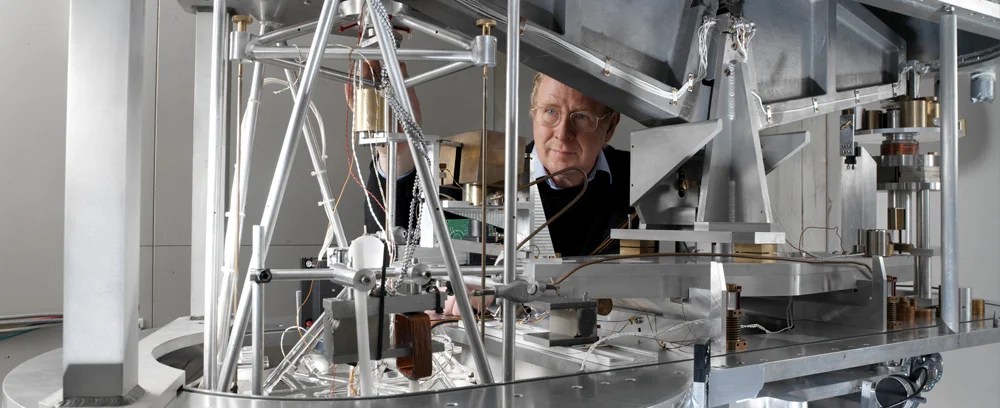
A Kibble balance works in two phases:
Phase 1 — Velocity mode: A conducting coil moves through a magnetic field at a carefully measured velocity . By Faraday's law, this induces a voltage: where is the product of the field strength and coil length.
Phase 2 — Force mode: The same coil, now stationary, carries a current that generates an upward force balancing the weight of a test mass:
Combining the two phases eliminates :
The electrical power is measured using quantum electrical standards — the Josephson effect (which relates voltage to the quantum of magnetic flux ) and the quantum Hall effect (which relates resistance to ). Both measurements bring Planck's constant into the equation:
where and are measurable frequencies. With fixed, and gravity measured by absolute gravimeters, the balance determines mass absolutely — with no reference to the IPK.
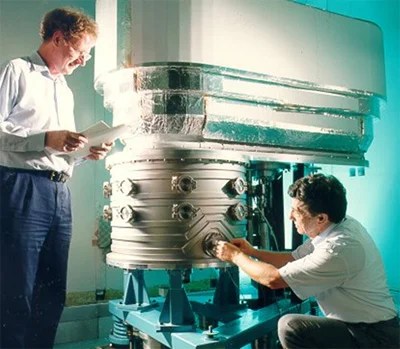
The Silicon Sphere Method
A completely independent route to the same result uses counting atoms.
If you know how many atoms are in a sample of material, and you know the mass of one atom, you know the total mass — no artifact required. The challenge is counting the atoms precisely.
The Avogadro project addressed this by manufacturing the most perfect spheres ever created: nearly flawless silicon-28 single crystals, polished to spheres with diameter uncertainty of a few nanometers — the most spherical man-made objects in history, more perfect than Earth's shape scaled up.
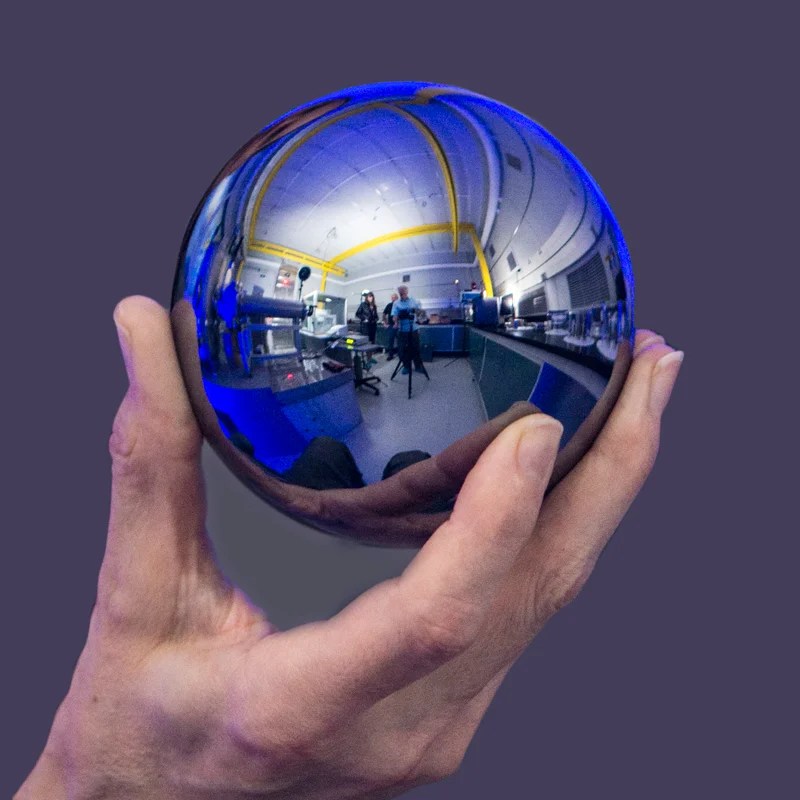
Silicon-28 is used because it is available in isotopically pure form (natural silicon contains three isotopes; using pure Si eliminates that uncertainty). By measuring the sphere's diameter (via laser interferometry), volume, and lattice constant (via X-ray diffraction), the number of unit cells in the sphere can be calculated. Since each unit cell of silicon contains 8 atoms, and the lattice constant is known from quantum theory, the number of atoms follows:
where is the lattice parameter. This gives Avogadro's number to extraordinary precision, which is directly related to Planck's constant through:
where , (fine structure constant), (relative atomic mass of the electron), (molar mass unit), and (Rydberg constant) are all known very precisely.
The 2019 Redefinition: All Seven Base Units
May 2019's revision was more comprehensive than just redefining the kilogram. All seven SI base units were redefined in terms of fundamental constants:
| Unit | Fixed Constant | Value |
|---|---|---|
| Second (s) | Cesium hyperfine frequency | 9,192,631,770 Hz |
| Meter (m) | Speed of light | 299,792,458 m/s |
| Kilogram (kg) | Planck's constant | J·s |
| Ampere (A) | Elementary charge | C |
| Kelvin (K) | Boltzmann's constant | J/K |
| Mole (mol) | Avogadro's constant | mol⁻¹ |
| Candela (cd) | Luminous efficacy | 683 lm/W |
The numerical values were chosen to match the previous definitions as closely as possible — so your bathroom scale still reads correctly. The change was in principle, not in practice.
The redefinition doesn't make measurements more precise — at the moment of the change, the uncertainty in the old and new systems was the same, by design. What it does is make the standard stable in a way no artifact can be. A kilogram defined by Planck's constant cannot be lost, cannot corrode, cannot drift over decades, and can be realized independently by any sufficiently equipped laboratory on Earth — or anywhere else in the universe where physics operates by the same laws.
Explore more simulations
Every concept on PhysicStuff has an interactive simulation. No login, no setup required.