🧪 General · 20 September 2017
Classical vs Quantum Computers
Classical computers have transformed civilization in 80 years, shrinking from room-filling vacuum tube machines to processors containing hundreds of billions of transistors on a chip smaller than a fingernail. Yet the principles of computation haven't changed since Alan Turing's 1936 theoretical model. Quantum computers represent a genuinely different computational paradigm — not faster classical computation, but a different kind of computation entirely, exploiting quantum mechanical phenomena that have no classical equivalent.
How Classical Computers Work
Every computation a classical computer performs — running a video game, sending an email, training an AI — ultimately reduces to manipulating bits: variables that are either 0 or 1, represented physically as transistors that are either off or on.
A modern processor is a dense array of metal-oxide-semiconductor field-effect transistors (MOSFETs). Each transistor acts as a voltage-controlled switch: a small voltage on the gate electrode allows current to flow between source and drain (the "1" state); removing the voltage blocks current (the "0" state). By combining millions of these switches into logic gates (AND, OR, NOT, NAND...) and then into complex circuits, we get everything from arithmetic units to memory cells.
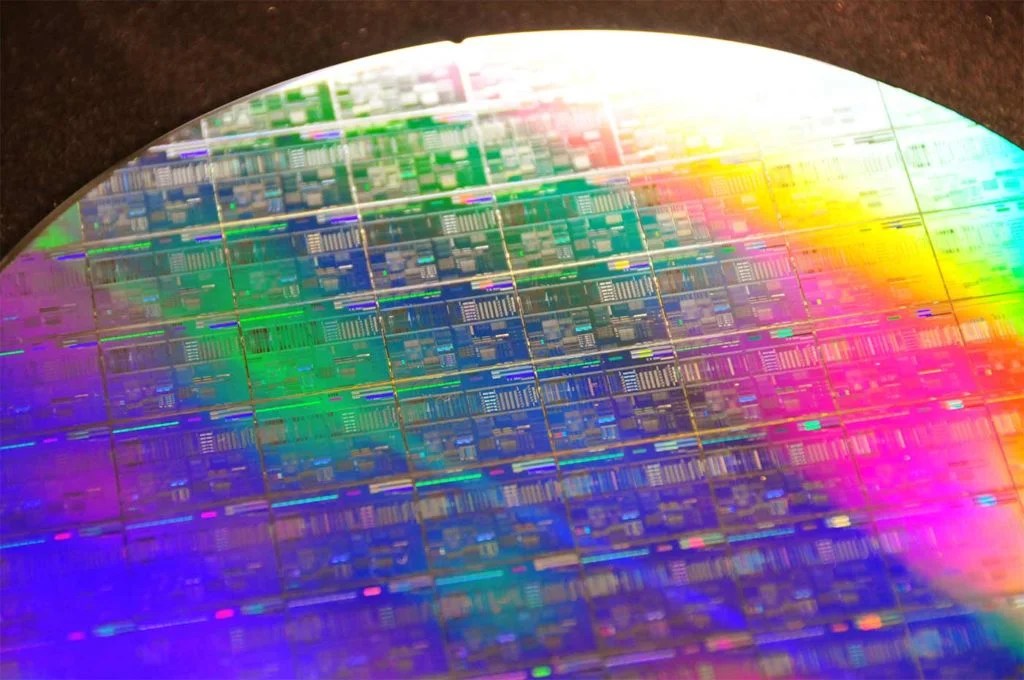
Moore's Law — the empirical observation by Intel co-founder Gordon Moore in 1965 that the number of transistors per chip doubles roughly every two years — held for about 50 years, driving the exponential improvement in computing power that defines the digital age. A 2023 Apple M3 Pro chip contains 37 billion transistors with features as small as 3 nanometers — about 15 silicon atoms across.
But Moore's Law is slowing. At 2-3 nm, transistors contain just a few dozen atoms in their critical dimensions. At this scale, quantum mechanical effects become significant:
- Quantum tunneling: Electrons tunnel through thin gate insulators instead of being blocked, causing leakage current and wasted energy
- Variability: Individual transistors differ from each other because they contain so few atoms that random fluctuations matter
- Heat: Packing more transistors generates more heat per unit area, and we're already near thermal limits
The path forward for certain problem classes is not to miniaturize further — it's to compute differently.
Qubits: The Quantum Bit
A classical bit can be 0 or 1. A qubit (quantum bit) can be in a superposition: a combination of 0 and 1 simultaneously, described by:
where and are complex numbers satisfying . The coefficients and are probability amplitudes: is the probability of measuring the qubit as 0, and as 1.
Crucial point: The superposition is not just "we don't know whether it's 0 or 1." The qubit is genuinely in both states simultaneously, with well-defined amplitudes that can interfere with each other like waves. When you measure the qubit, the superposition collapses to either 0 or 1 probabilistically — but before measurement, both values influence the computation.
Visually, a qubit's state can be represented as a point on the Bloch sphere: the north pole represents , the south pole , and any point on the sphere surface represents a valid superposition.
Entanglement: Non-Classical Correlations
The second key quantum resource is entanglement. Two qubits can be prepared in a joint state where their measurement outcomes are correlated in ways impossible for classical systems:
This is a Bell state: measuring the first qubit as 0 guarantees the second is 0; measuring it as 1 guarantees the second is 1 — regardless of how far apart they are. Einstein called this "spooky action at a distance" and found it deeply troubling. Experiments beginning with Alain Aspect in 1982 (and recently earning the 2022 Nobel Prize) have confirmed these correlations are real and cannot be explained by any local hidden variable theory.
The computational power of entanglement: for entangled qubits, the state space has complex amplitudes that must be tracked simultaneously. A 50-qubit system has amplitudes — already beyond what a classical computer can efficiently simulate. A 300-qubit system has more states than there are atoms in the observable universe.
Quantum Gates and Algorithms
Quantum computations are performed by applying quantum gates — unitary operations that rotate the state of qubits in Hilbert space. Common gates include:
| Gate | Effect | Classical Analogue |
|---|---|---|
| Hadamard (H) | Creates equal superposition of 0 and 1 | None |
| CNOT | Flips target qubit if control qubit is 1 | XOR gate |
| Pauli-X | Bit flip: swaps 0 and 1 | NOT gate |
| T gate | Phase rotation by | None |
| Toffoli (CCNOT) | Flips target if both controls are 1 | NAND (universal) |
A quantum algorithm is a carefully designed sequence of gates that uses quantum interference to amplify correct answers and cancel wrong answers — steering the computation toward the desired result. The skill is in designing gate sequences where interference works in your favor.
Key algorithms:
Shor's algorithm (1994): Factors large integers in polynomial time. A classical computer factoring a 2048-bit number (used in RSA encryption) would take longer than the age of the universe. Shor's algorithm could do it in hours on a sufficiently large quantum computer. This is why quantum computing poses a threat to current public-key cryptography — and why post-quantum cryptographic standards are being developed now.
Grover's algorithm (1996): Searches an unsorted database of items in time instead of the classical . Not exponential speedup, but a quadratic one — significant for optimization and cryptographic problems.
Variational Quantum Eigensolver (VQE): A near-term algorithm for finding the ground-state energy of quantum systems — directly useful for modeling molecular chemistry, drug design, and materials discovery.
Physical Implementations
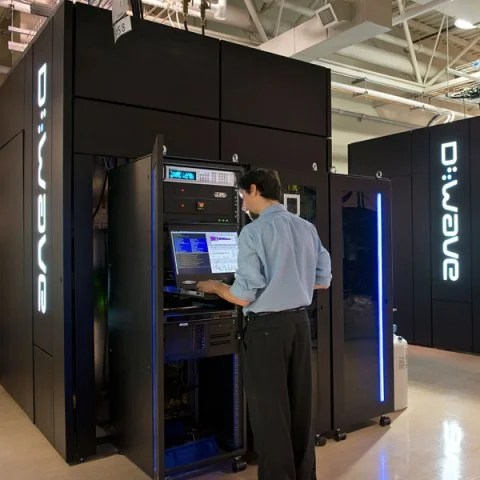
Building a qubit requires a physical system with two distinguishable quantum states. Many platforms are under active development:
| Platform | Qubit | Temperature Required |
|---|---|---|
| Superconducting circuits | Josephson junction energy levels | ~15 mK |
| Trapped ions | Electronic energy levels of ions | ~1 mK (ion trap) |
| Photonics | Photon polarization or path | Room temperature |
| Spin qubits | Electron spin in semiconductor | ~100 mK |
| Neutral atoms | Atomic energy levels in optical tweezers | ~microkelvin |
| Topological qubits | Non-Abelian anyons | ~100 mK (theoretical) |
Superconducting qubits (used by Google, IBM, Rigetti) are the current frontrunners for scale. Their main vulnerability is decoherence.
The Decoherence Problem
Quantum states are extraordinarily fragile. Any interaction with the environment — a stray photon, a vibrating atom nearby, electromagnetic noise — can destroy the superposition. When a qubit interacts with its environment, it undergoes decoherence: the quantum information leaks into the environment, and the qubit's state becomes a classical probabilistic mixture rather than a quantum superposition.
Typical decoherence times for superconducting qubits: 50–500 microseconds. A gate operation takes about 10-50 nanoseconds. So a qubit can sustain roughly 1,000–50,000 gate operations before decoherence destroys the computation. For large-scale algorithms like Shor's, millions or billions of logical gate operations are needed — requiring quantum error correction.
Quantum Error Correction
Classical computers correct errors by redundancy: replicate data three times, take the majority vote. Quantum error correction is subtler because you cannot copy a quantum state (the no-cloning theorem forbids it) and you cannot measure a qubit without collapsing its state.
The solution uses quantum codes: logical qubits encoded redundantly across many physical qubits in ways that allow errors to be detected and corrected without measuring the logical information. The leading approach, the surface code, requires approximately 1,000 physical qubits per logical qubit at realistic error rates. A fault-tolerant Shor's algorithm attacking RSA-2048 would require millions of physical qubits.
Current state-of-the-art systems (2024): Google's Willow processor has 105 qubits; IBM's quantum systems have reached 1,000+ qubits; but these are noisy, uncorrected physical qubits, not fault-tolerant logical qubits.
What Quantum Computers Are Actually Good At
Quantum computers are not universally faster. They excel at specific problem structures:
- Simulation of quantum systems: Modeling molecular chemistry, drug interactions, and materials with quantum effects. This is arguably the "killer app" — classical computers are exponentially bad at simulating quantum mechanics.
- Cryptography: Shor's algorithm threatens RSA/ECC encryption; Grover's algorithm weakens symmetric keys.
- Optimization: Certain combinatorial optimization problems may see quantum speedups.
- Linear algebra: HHL algorithm offers exponential speedup for solving linear systems (with important caveats about input/output).
They are not better for: most everyday computing, browsing the web, running applications, most machine learning training (though quantum ML is an active research area).
The honest assessment in 2024: We are in the NISQ era (Noisy Intermediate-Scale Quantum). Current quantum computers have demonstrated proof-of-concept quantum advantage on specific, carefully chosen problems, but no quantum computer has yet solved a practically relevant problem faster than the best classical computer could. Fault-tolerant quantum computation — needed for Shor's algorithm and most practical applications — likely requires another 10–20 years of development. The journey from classical to quantum computing is real, important, and genuinely exciting — but it is not imminent.
Explore more simulations
Every concept on PhysicStuff has an interactive simulation. No login, no setup required.