🧪 General · 6 October 2018
Nobel Prize in Physics 2018: Tools That Opened New Worlds
The Nobel Committee sometimes honors discoveries — new particles, new phenomena, new laws. But occasionally it honors tools: instruments that open previously inaccessible doors. The 2018 Nobel Prize in Physics was one of these. It was awarded to three researchers whose inventions didn't just advance physics but created entirely new fields of it.
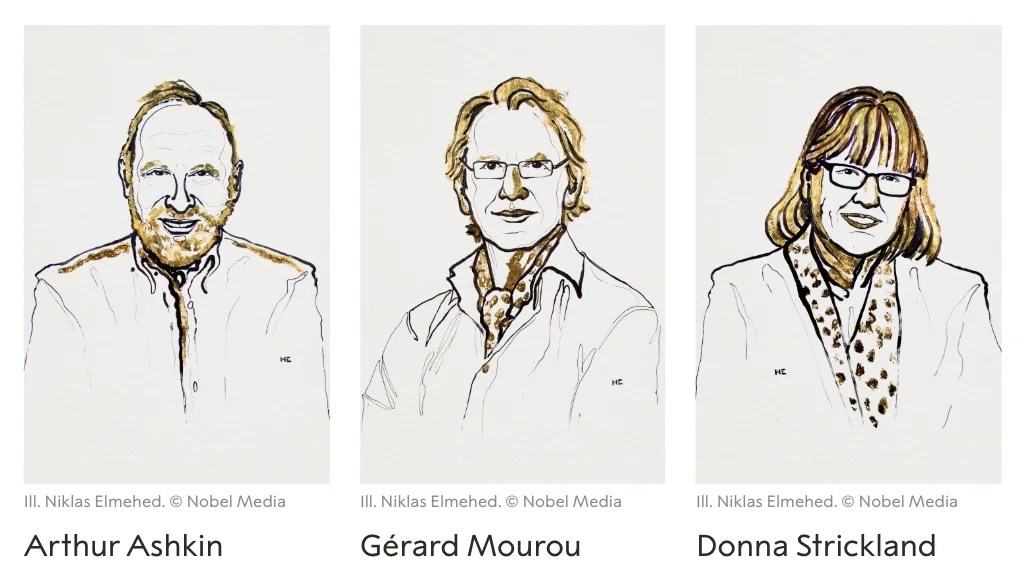
Arthur Ashkin received one half for the invention of optical tweezers. Gérard Mourou and Donna Strickland shared the other half for developing chirped pulse amplification — a technique that made the most powerful lasers in the world possible.
Part I: Optical Tweezers — Holding the World's Smallest Objects with Light
Historical Background
The idea that light can push things goes back to Johannes Kepler, who in 1619 proposed that comet tails point away from the Sun because of "light pressure" — the push of sunlight. James Clerk Maxwell formalized this in 1873, showing theoretically that electromagnetic radiation carries momentum. Experimental confirmation came in 1900-1903 when Pyotr Lebedev in Russia and Ernest Nichols and Gordon Hull in the US independently measured radiation pressure directly.
But measuring the pressure of light on macroscopic objects requires sensitive apparatus — the force is tiny. On a microscopic particle, however, things get more interesting.
Ashkin's Discovery
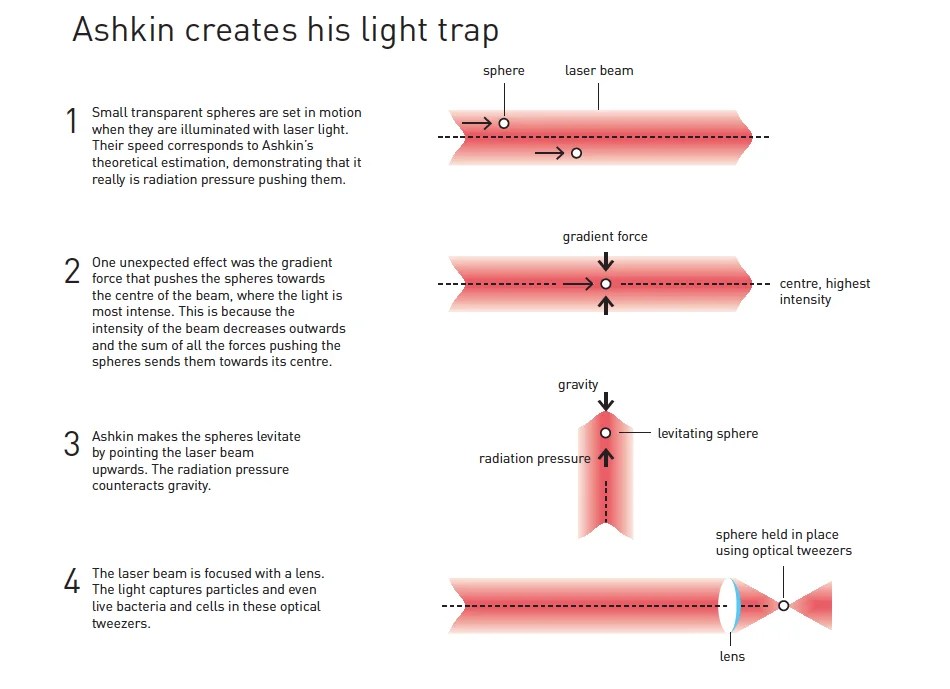
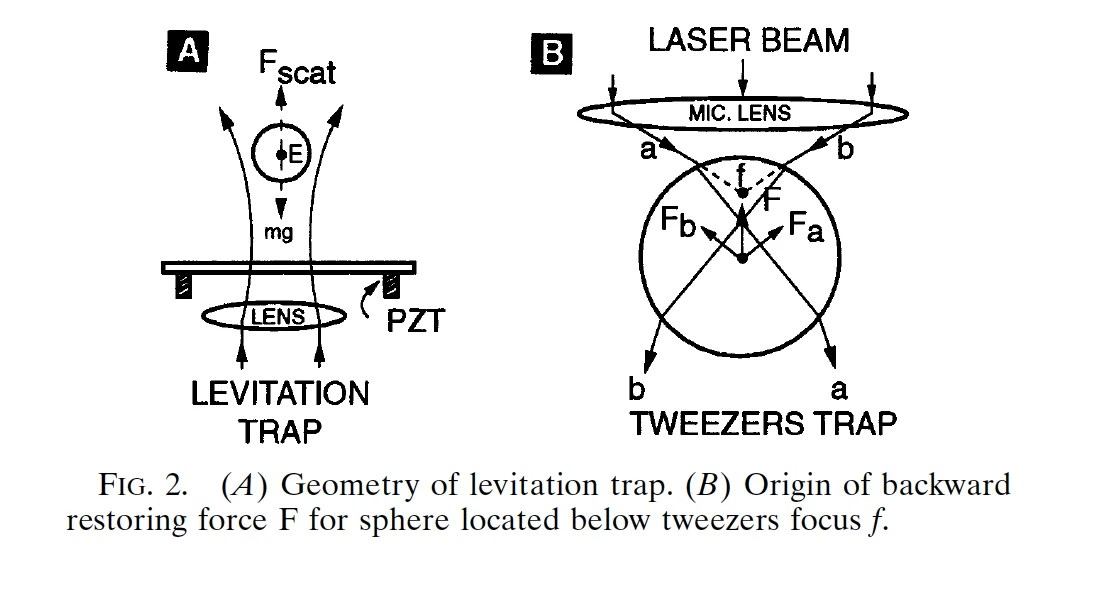
Arthur Ashkin at Bell Labs began experimenting with focused laser beams in the 1960s. In 1970, he made a crucial observation: a focused laser beam could push a small transparent sphere sideways — toward the beam axis — and this transverse force was strong enough to balance gravity and hold the sphere stably in the beam.
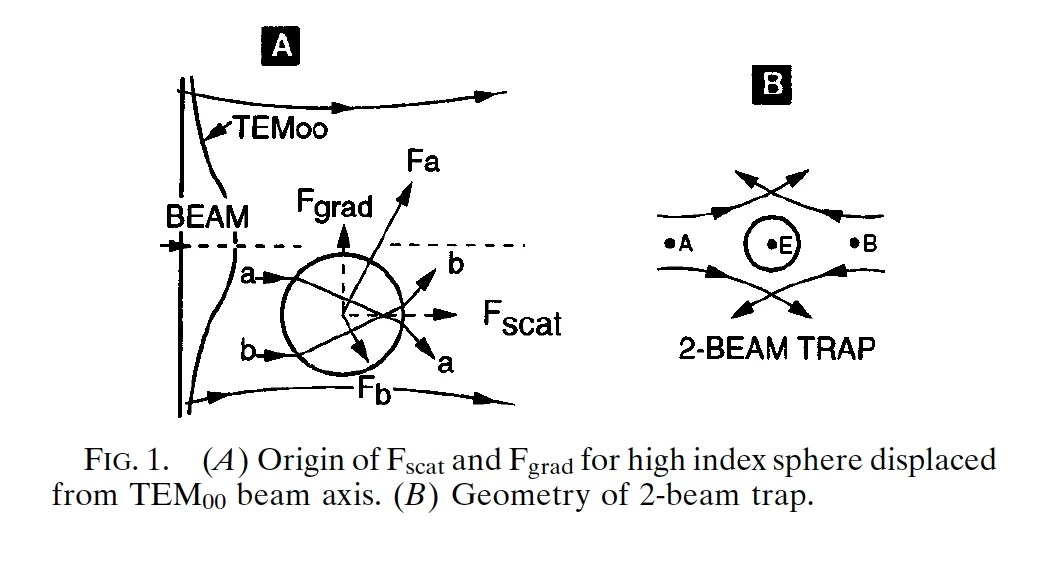
The physical origin: a Gaussian laser beam has maximum intensity at its center. A transparent sphere acts as a lens, refracting the beam. By Newton's third law, if the sphere deflects photons sideways (away from the center), the photons push the sphere sideways (toward the center). This gradient force is directed toward the region of highest intensity — the beam center.
In 1986, Ashkin combined the gradient force with a second force — the scattering force pushing particles in the beam direction — and showed that a single tightly focused laser beam could trap particles in all three dimensions, levitating them at the focus point. This was the optical trap, or optical tweezers.
The quantitative framework: the gradient force on a particle much smaller than the wavelength (Rayleigh regime) is:
where is the particle's polarizability and is the gradient of the electric field intensity. This force points toward the intensity maximum.
What Optical Tweezers Can Do
The trapping forces are in the piconewton ( N) range — weak enough not to damage biological molecules, strong enough to trap them firmly.
Ashkin immediately recognized the biological implications. In 1987, his team trapped living bacteria in an optical trap for the first time — and showed they survived, unharmed. This opened a new branch of biophysics.
Modern applications include:
Molecular motors: Proteins like myosin, kinesin, and dynein are nanoscale machines that walk along filaments inside cells, transporting cargo. By attaching a microscopic bead to one end of a molecular motor protein and trapping the bead, researchers can measure the force a single motor exerts (a few piconewtons), its step size (8 nm for kinesin), and how it responds to mechanical loads. This was simply impossible before optical tweezers.
DNA mechanics: DNA can be stretched between two optically trapped beads and its elastic properties measured directly. The stretching of a single DNA molecule can be followed base-by-base as proteins bind to it. RNA polymerase unzipping a double helix can be watched in real time.
Colloidal physics: The interaction forces between colloidal particles can be measured with piconewton precision — crucial for understanding self-assembly and designing new materials.
Cell mechanics: Individual red blood cells can be deformed by optical tweezers to measure their membrane stiffness — a diagnostic for diseases like malaria that stiffen cell membranes.
Arthur Ashkin was 96 years old when he received the Nobel Prize — the oldest Nobel laureate in any field.
Part II: Chirped Pulse Amplification — Lasers at Extreme Power
The Intensity Wall
By the mid-1980s, laser physicists had a problem: every attempt to push laser pulse power higher hit a wall. High-intensity pulses damaged the optical components — particularly the gain medium (the material that amplifies the laser) — due to nonlinear optical effects and simply heating. The more powerful you tried to make the pulse, the more likely it was to destroy the laser itself.
The peak powers achievable were stuck at around watts (100 gigawatts) — impressive by everyday standards, but not nearly enough for the most demanding applications.
The CPA Solution
In 1985, Gérard Mourou and Donna Strickland (then a Ph.D. student at Rochester) published a technique that solved this problem elegantly: Chirped Pulse Amplification (CPA).
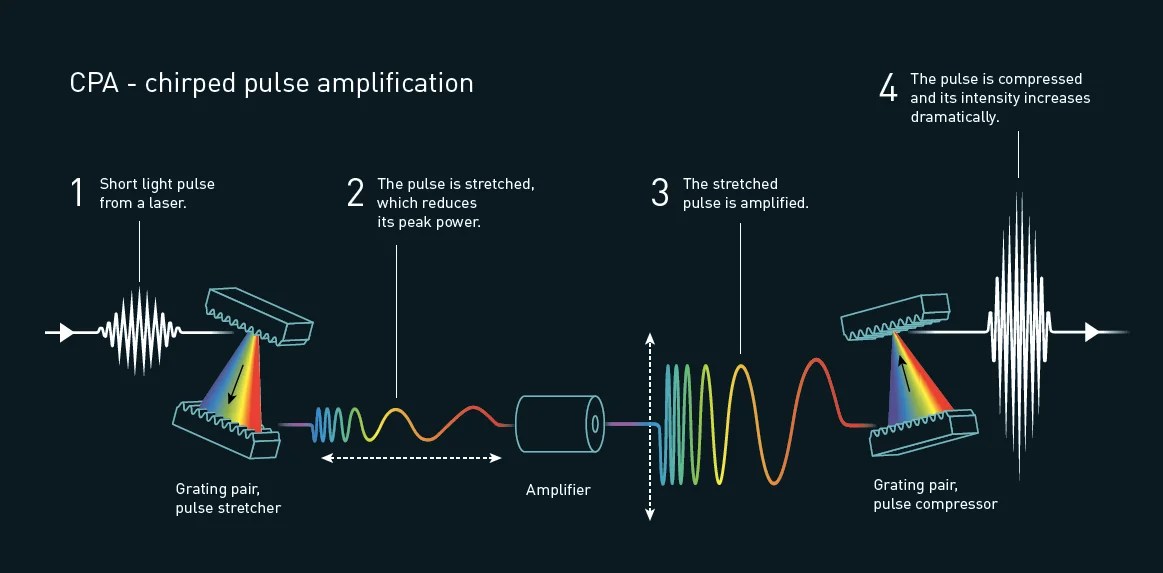
The key insight was borrowed from radar engineering: stretch the pulse in time before amplifying it, then compress it afterward. Specifically:
Step 1 — Stretch: A short laser pulse (femtoseconds to picoseconds) is passed through a dispersive element — a pair of diffraction gratings or a length of optical fiber. Different wavelengths travel different distances, causing the pulse to be stretched in time by a factor of 1,000–100,000. The stretched pulse is called a chirped pulse (by analogy with a chirping bird, where frequency changes with time). Its peak power is now 1,000–100,000 times lower.
Step 2 — Amplify: The chirped (low-power) pulse is passed through the gain medium and amplified by a factor of – without risk of damaging anything, because the power is still low.
Step 3 — Compress: The amplified, stretched pulse is passed through another dispersive element (oriented opposite to the first) that reverses the stretching. The pulse is compressed back to its original short duration — but now contains – times more energy.
The result: pulse energies that were previously impossible, with peak powers reaching petawatts ( W). Today's most powerful lasers achieve intensities of W/cm² at their focus — recreating in a tiny spot conditions that existed in the early universe.
CPA became the standard technique for all subsequent high-intensity ultrafast lasers. The technique works across wavelengths from X-ray to infrared.
Applications of CPA Lasers
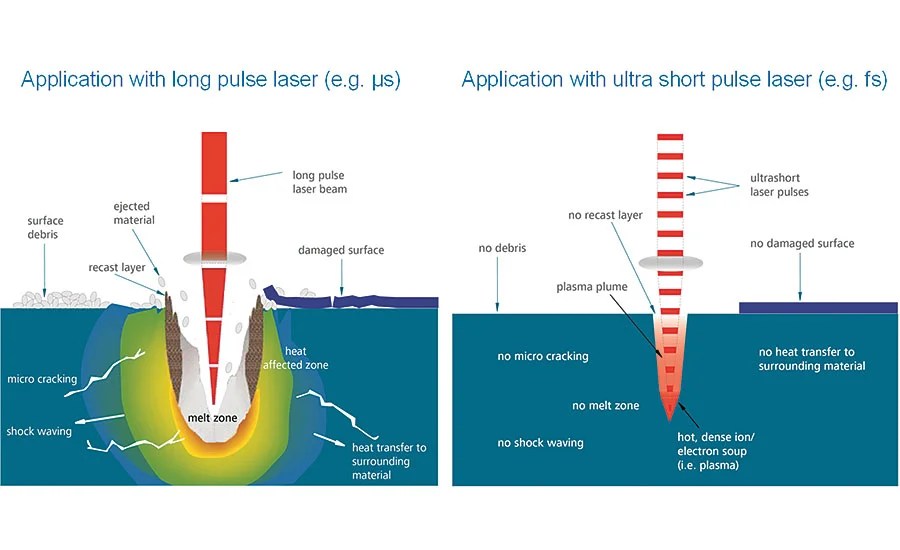
Laser eye surgery (LASIK and SMILE): Ultrashort pulses deposit their energy in an extremely thin layer of tissue with minimal heat transfer to surrounding areas — allowing precise removal of corneal tissue without thermal damage. Over 40 million LASIK procedures have been performed worldwide using CPA-derived laser technology.
Ultrafast science: CPA lasers enable pump-probe experiments: one pulse initiates a reaction (the "pump"), a delayed second pulse photographs it (the "probe"). Pulse durations of a few femtoseconds ( s) are short enough to capture the motion of electrons in atoms and molecules — the foundation of the field of attosecond physics (2023 Nobel Prize in Physics).
Particle acceleration: Intense laser pulses can accelerate electrons and protons to MeV energies over distances of millimeters — using the laser's electromagnetic field directly, rather than conventional meter-long radiofrequency cavities. Laser plasma acceleration could eventually create compact particle accelerators.
Material processing: Ultrashort pulses machine materials with extreme precision. Because the pulse deposits energy faster than the material can thermally expand, there is no heat-affected zone — no melted edges, no micro-cracks. Used for cutting glass, drilling holes in turbine blades, and manufacturing stents.
Nuclear fusion research: Petawatt lasers are being studied for fast ignition in inertial confinement fusion — compressing fusion fuel to conditions hot and dense enough to burn.
Donna Strickland was only the third woman to receive the Nobel Prize in Physics, following Marie Curie (1903) and Maria Goeppert Mayer (1963). At the time of the award, she was a full professor but did not hold the title of "full professor" — she was an associate professor at Waterloo. Her institution promoted her after the Nobel announcement.
Explore more simulations
Every concept on PhysicStuff has an interactive simulation. No login, no setup required.