🧪 General · 3 September 2017
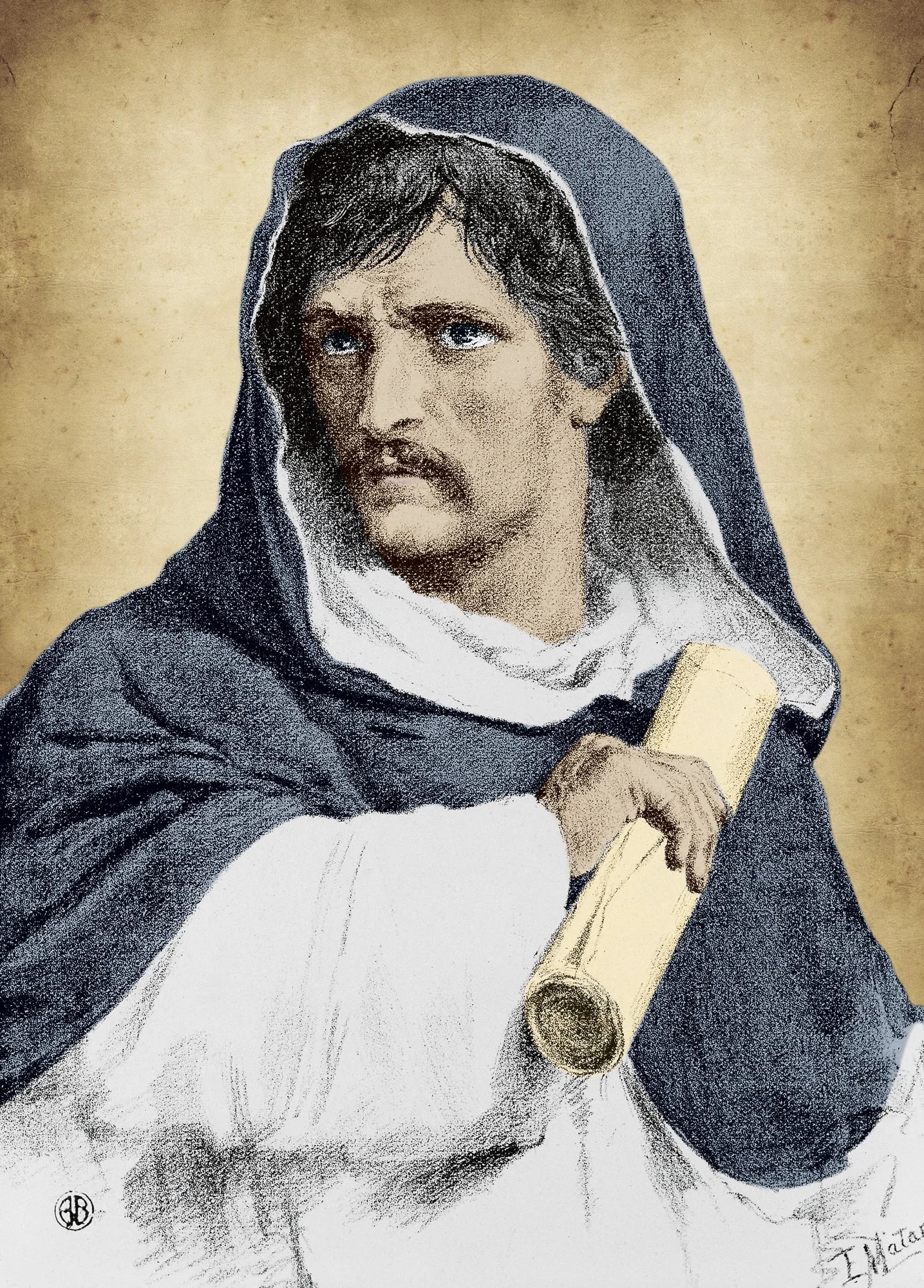
Giordano Bruno: A Born Rebel
Before the telescope, before the satellite photograph, before any instrument could show us the shape of the cosmos, the question of what the universe looked like was entirely a matter of philosophy, theology, and naked-eye observation. For most of Western history, the answer seemed self-evident: the Sun, Moon, planets, and stars revolve around a stationary Earth at the center of everything. God's creation was finite, ordered, and Earth was its privileged center.
Into this worldview stepped a Dominican monk from Naples who argued, without instruments, that the universe was infinite — filled with countless stars, each perhaps surrounded by their own worlds — and who paid for this belief with his life.
The World Before Copernicus
The geocentric model — Earth at the center — had been formalized by Ptolemy in the 2nd century CE and inherited by medieval Europe. It was not simply ignorance: Ptolemaic astronomy was a sophisticated mathematical system that predicted planetary positions with reasonable accuracy for navigation and calendar purposes. It was also deeply intertwined with theology: a finite, Earth-centered universe mapped neatly onto Christian cosmology, with Heaven above and Hell below, and humanity at the pivot of creation.
In 1543, Polish astronomer Nicolaus Copernicus published De revolutionibus orbium coelestium — proposing that Earth orbits the Sun rather than the reverse. He was careful: the book was dedicated to the Pope, framed as a mathematical convenience rather than a physical claim about reality, and published as Copernicus was dying. The Church initially left it alone.
But Copernicus's model had profound implications. If Earth is not the center, what is so special about humanity's place? And if there are other planets orbiting the Sun, might there be other worlds?
The Young Rebel
Giordano Bruno was born in Nola, near Naples, in 1548 — five years after De revolutionibus appeared. He joined the Dominican Order and trained in philosophy and theology, but almost immediately ran into trouble with the authorities. He read banned books — particularly Erasmus's critical biblical commentary — and had an inquisitive, combative temperament poorly suited to monastic life.
He discovered Lucretius's ancient Epicurean poem De rerum natura (On the Nature of Things), written in 50 BCE, which argued for an infinite universe composed of atomic particles. In it he found a simple, devastating argument for infinity:
If you stand at the edge of the universe and throw a spear, either it goes through — proving there is something beyond the edge — or it hits a wall. But then that wall is beyond the supposed edge. Either way, there is more beyond. The universe must be infinite.
Bruno did not just accept this argument — he embraced it as theologically necessary. An infinite God, he reasoned, could only express His infinite power through an infinite creation. A finite universe would be an insult to God's boundlessness.
The Infinite Universe
Bruno went further than Copernicus. Copernicus merely moved the center from Earth to the Sun. Bruno dissolved the center entirely:
- The universe is infinite in extent — it has no edge, no center, no privileged location.
- The stars are distant suns — each as vast and luminous as our own.
- Many of these suns may have planets orbiting them — other worlds, possibly with their own living things.
- The Earth is not special. Humanity is not cosmically privileged.
These ideas were not based on observation — Bruno had no telescope (that invention was still half a century away). They were philosophical and theological arguments, grounded in Neoplatonist tradition and Lucretian atomism. Yet they turned out to be correct in their broad strokes: the universe is indeed vast beyond ancient comprehension, stars are distant suns, and thousands of exoplanets orbiting other stars have now been confirmed.
Across Europe: Rejection Everywhere
Bruno was convinced that if he presented his ideas eloquently enough, people would embrace them as a grander vision of God's creation. He traveled across Europe, writing and lecturing:
Geneva, 1579: Joined the Calvinist community. Expelled and excommunicated after publicly attacking a leading Calvinist philosopher in a pamphlet. He left.
Paris, 1581: Lectured at the Sorbonne to considerable interest. Met the French king Henri III. Published several books on memory systems (for which he was genuinely respected) and on his cosmological ideas.
England, 1583–1585: Visited Oxford, where he lectured on Copernican astronomy. His lectures were interrupted when Oxford scholars accused him of plagiarism — apparently he had borrowed too liberally from a book by Ficino without attribution. He found the English academic establishment narrow-minded and petty.
Germany, 1586–1590: Lecturing at various universities. Excommunicated by the Lutherans in Helmstedt after a dispute. He could not remain.
Venice, 1591: A Venetian nobleman, Giovanni Mocenigo, invited Bruno to Venice to learn his memory arts. Bruno accepted, despite knowing the danger of being back in Italian territory under the reach of the Inquisition.
The Inquisition
In 1592, Mocenigo — apparently disappointed that Bruno had not taught him all the secrets he promised, or simply feeling threatened — denounced Bruno to the Venetian Inquisition. Bruno was arrested.
The Roman Inquisition requested his extradition to Rome, which Venice reluctantly granted in 1593. Bruno spent the next seven years in the prisons of the Inquisition, interrogated repeatedly about his beliefs.
The specific charges were theological rather than astronomical: denying the Trinity, denying the divinity of Christ, believing in the transmigration of souls, practicing magic, denying the Virgin Birth. The Inquisition was less concerned with heliocentrism per se than with Bruno's broader theological heterodoxy — his whole system was incompatible with orthodox Christianity.
Bruno negotiated, partially recanted, re-asserted. He refused to disavow what he considered his central philosophical insights — the infinity of the universe, the plurality of worlds. After seven years of imprisonment and failed negotiations, Pope Clement VIII declared him an impenitent heretic.
February 17, 1600
On the morning of Ash Wednesday, 1600, Giordano Bruno was led to the Campo de' Fiori — the Field of Flowers, a popular market square in Rome. A contemporary account notes that when the death sentence was read to him, Bruno replied: "Perhaps your fear in passing judgment on me is greater than mine in receiving it."
He was burned at the stake.
Contemporary accounts say his tongue was gagged — he was not permitted to speak final words to the crowd. According to the Venetian ambassador's account, he turned away from the crucifix held out to him.
Today, a bronze statue of Bruno stands in the Campo de' Fiori, erected in 1889 over the objections of the Vatican — hooded, looking downward at the exact spot where he died. It has become a site of pilgrimage for those who see Bruno as a martyr for free thought.
Was Bruno a Scientist?
This is contested. Bruno made no observations, developed no mathematical models, proposed no testable predictions. He was a philosopher and a theologian, not a scientist in the modern sense. His arguments for infinity and plurality were deductive and a priori, not empirical.
He was also deeply interested in Hermeticism — a mystical Renaissance tradition involving magic, astrology, and the occult. Some historians argue his advocacy for heliocentrism was as much mystical as rational — the Sun at the center appealed to him as a symbol of divine light at the heart of creation.
Yet he arrived at conclusions that later science confirmed: the stars are distant suns, the universe contains other worlds, no point in space is privileged. Whether this counts as scientific insight or lucky philosophical speculation is a matter of interpretation.
The Legacy
Bruno became a symbol — of intellectual freedom versus religious authority, of the individual conscience versus institutional power. The 19th-century free thought movement adopted him enthusiastically. The statue in Campo de' Fiori was specifically erected as a secular provocation to the Vatican.
The truth is more nuanced. Bruno was not killed for heliocentrism — Galileo advocated heliocentrism 30 years later and was merely placed under house arrest. Bruno was killed for a comprehensive theological heterodoxy: he denied core Christian doctrines, not merely challenged biblical astronomy.
But his cosmological vision — the infinite universe, the plurality of worlds — was genuinely ahead of its time, arrived at by pure reasoning, and stands as one of the more remarkable intellectual achievements of the Renaissance.
The Field of Flowers today is a busy tourist square full of restaurants and market stalls. Every morning, the flowers and produce fill the space where Bruno died. The hooded statue watches from the center. On February 17 each year — the anniversary of his execution — flowers are laid at its base.
Explore more simulations
Every concept on PhysicStuff has an interactive simulation. No login, no setup required.