⚡ Electromagnetism · 7 March 2018
How Does Lightning Occur?
A typical cloud-to-ground lightning stroke lasts less than half a second, carries a peak current of around 30,000 amperes, heats the surrounding air to 30,000 K (five times the surface temperature of the Sun), and releases about 1–5 gigajoules of energy. It is one of the most violent phenomena that regularly occurs on Earth, and it happens about 100 times per second across the globe. Understanding its physics requires looking at electrostatics, fluid dynamics, and atmospheric chemistry all at once.
The Charge Separation Problem
A thundercloud doesn't arrive pre-charged. The charge builds up dynamically inside the storm through a process that physicists still debate in its details — but the broad outlines are well understood. The underlying physics involves electric fields reaching magnitudes that exceed the dielectric strength of air.
Inside a vigorous cumulonimbus cloud, powerful updrafts carry air upward at speeds of up to 50 m/s. Near the freezing level, the cloud contains a mixture of:
- Supercooled water droplets (liquid water below 0°C)
- Ice crystals (small, light, carried upward)
- Graupel (larger, rimed ice pellets that fall or remain suspended)
When ice crystals collide with graupel in the presence of supercooled water, charge is transferred — graupel becomes negatively charged, ice crystals become positively charged. The updraft carries the light, positively charged ice crystals to the top of the cloud, while the heavier, negatively charged graupel concentrates in the middle and lower regions.
The result: the upper cloud becomes positive, the lower cloud becomes negative, and a negative charge is induced on the ground directly below by electrostatic induction (positive charges in the ground are attracted toward the surface, negative charges in the ground are repelled away).

The electric field between cloud and ground can exceed 10 kV/m — far beyond air's dielectric strength of about 3 kV/m. When the field reaches the breakdown point, ionization cascades through the air and a discharge is imminent.
The Stepped Leader
Lightning doesn't simply leap from cloud to ground in one stroke. The process is far more intricate.
First, an invisible stepped leader propagates downward from the cloud in discrete steps of about 50 meters each, with about 50 microseconds between steps. Each step is a brief burst of ionization that extends a conductive plasma channel downward. The leader is dim — invisible or barely visible — and branches in multiple directions as it searches for the path of least resistance.
As the leader approaches the ground, the intense electric field at its tip triggers streamers rising upward from tall objects on the ground — trees, buildings, antennas, hilltops. These upward-moving positive leaders reach up toward the negative stepped leader.
When one connecting streamer meets the downward leader — typically at a height of 10–100 meters — the circuit closes.
The Return Stroke: The Flash We See
The moment the circuit closes, a brilliant return stroke propagates upward from the ground to the cloud at about 1/3 the speed of light (~100,000 km/s). This return stroke is what we see as the lightning bolt. It carries currents up to 200,000 amperes and superheats the plasma channel to ~30,000 K.
This extreme heating causes the air to expand explosively — far faster than the speed of sound — creating the shockwave we hear as thunder.
Thunder: Why It Rumbles
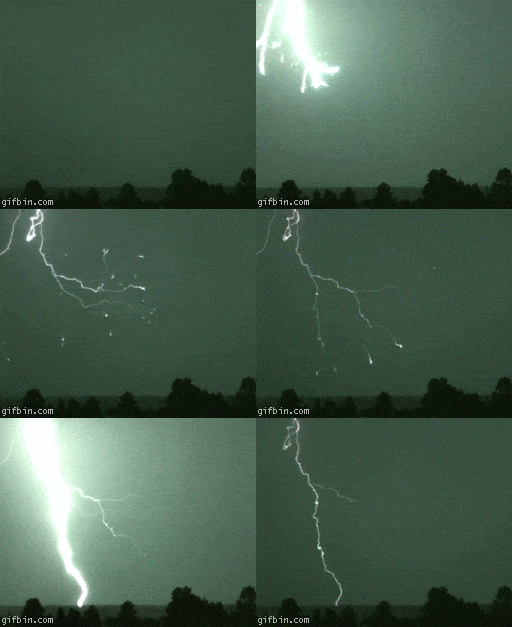
The lightning channel can be several kilometers long, and different parts of it are at different distances from your ears. The sound from the nearest part arrives first; sound from progressively farther parts of the branched, tortuous channel arrives later, spread over several seconds.
Additionally, sound reflects off buildings, hills, and the underside of the cloud itself. The result is the characteristic rumble of distant thunder, rather than a sharp crack. Near a strike, you hear just the crack — the channel is nearby and short, so all parts of it are at nearly the same distance.
The time between flash and thunder gives the distance: sound travels at about 343 m/s at 20°C, so count the seconds from flash to thunder and divide by 3 to get kilometers (or divide by 5 for miles).
Types of Lightning
Intra-cloud (IC)
The most common type — discharge occurring entirely within the cloud between differently charged regions. Accounts for roughly 75% of all lightning.
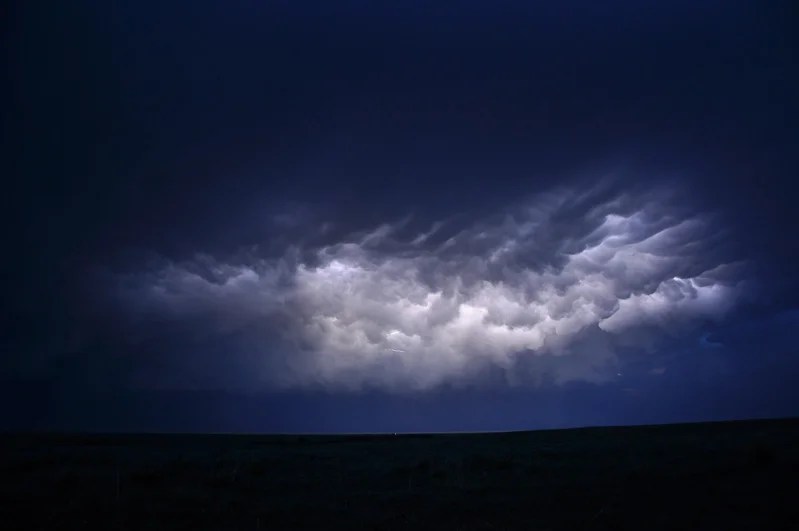
Cloud-to-Cloud (CC)
Discharge between separate clouds. Less common than IC.
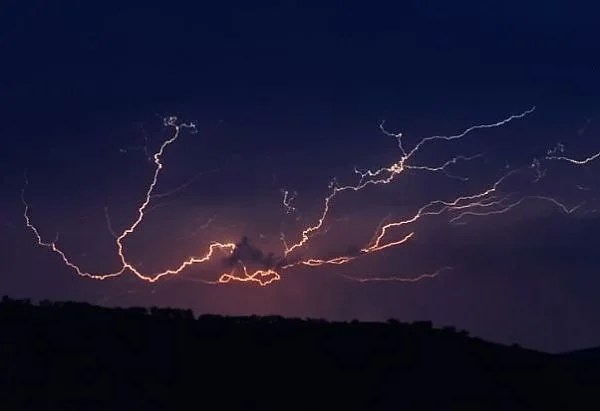
Cloud-to-Ground (CG)
The most studied and most dangerous type. Only about 25% of lightning, but most consequential for humans and infrastructure. Can be negative (negative charge transferred to ground, most common) or positive (positive charge from the top of the cloud to the ground — rarer, longer, and more powerful).
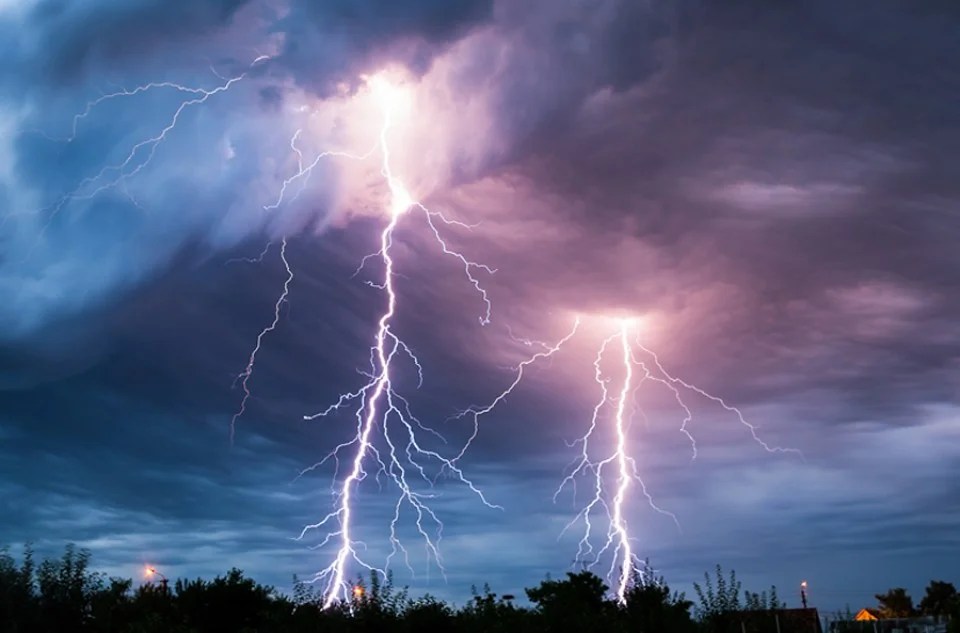
Cloud-to-Air (CA)
Discharge between the cloud and the ambient clear air around it.
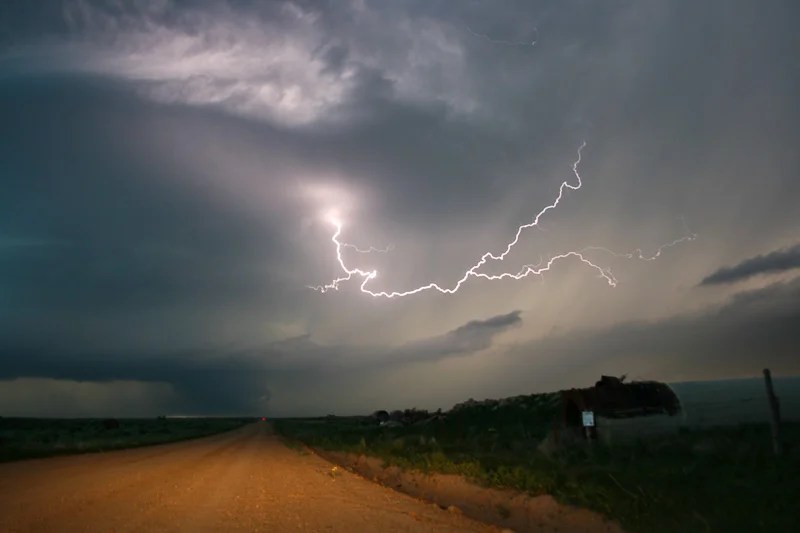
Ball Lightning: The Persistent Mystery
Classical lightning physics cannot explain ball lightning — reports of luminous, floating spheres, ranging from golf-ball to beach-ball size, that drift slowly through the air for seconds or minutes before fading or exploding. Reports are widespread across cultures and centuries, but the phenomenon has never been reliably captured on controlled video or reproduced in a laboratory. Hypotheses range from plasma vortices to microwave-induced combustion to quantum processes, but no consensus exists.
The Global Electric Circuit
Lightning is not merely a local phenomenon — it is part of a global electric circuit. Thunderstorms worldwide continuously pump electric charge from the surface to the upper atmosphere (the ionosphere), maintaining a potential difference of about 300,000 volts between the ionosphere and the ground. In fair-weather regions (no thunderstorm), a gentle downward electric field of ~100 V/m exists at the surface — you are standing in an electric field right now. The global circuit was first described by the atmospheric physicist C.T.R. Wilson (who also invented the cloud chamber and won the 1927 Nobel Prize) in 1921.
Lightning Safety
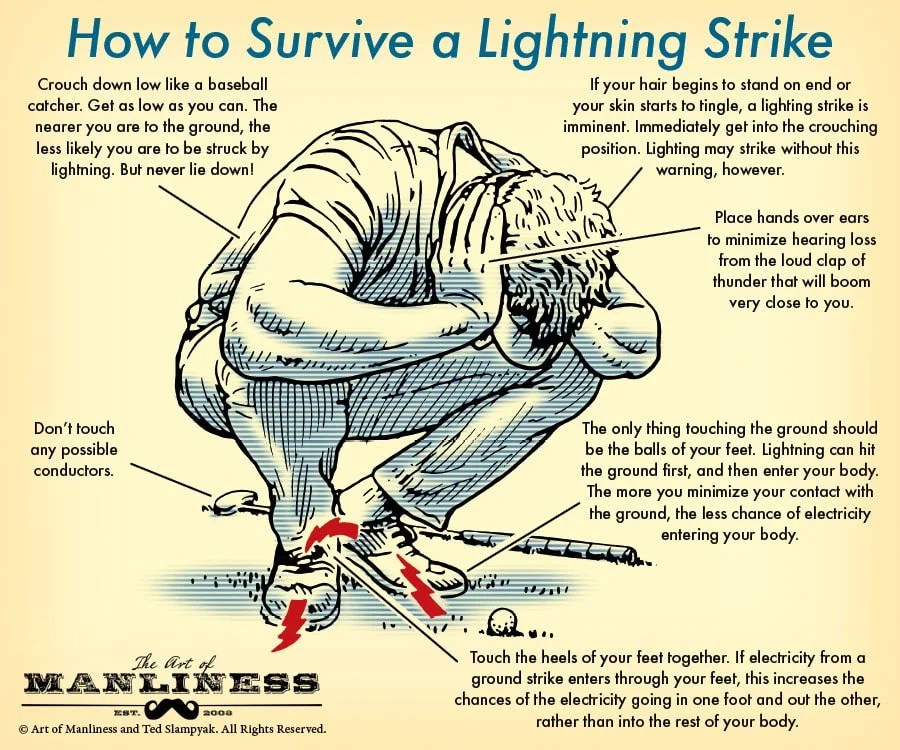
If you are caught outdoors with no shelter available:
- Avoid the tallest object in the area — trees, poles, towers. Lightning preferentially strikes tall objects because the electric field enhancement at their tips initiates upward streamers.
- Crouch low on the balls of your feet, feet together, hands over ears. Minimize your height and ground contact area simultaneously.
- Spread out your group — if lightning strikes nearby, don't let current pass through multiple people via their shared ground contact.
- Get off ridges, hilltops, and open fields — elevation dramatically increases your exposure.
- A vehicle is safe — the metal shell forms a Faraday cage. Do not touch metal surfaces inside.
- Never shelter under isolated trees or lie flat on the ground.
The Faraday cage principle: The reason cars are safe isn't rubber tires — it's the metal body. When lightning strikes a car, current flows through the outer shell and disperses into the ground through the tires (which may ionize under the high voltage). The interior is shielded because electrical charge on a conductor distributes on the exterior surface, not through the interior. This is the Faraday cage effect, discovered by Michael Faraday in 1836.
Explore more simulations
Every concept on PhysicStuff has an interactive simulation. No login, no setup required.