🔭 Astrophysics · 16 August 2018
How Do Astronomers Determine Stellar Distances?
Distance is the hardest measurement in astronomy. You cannot physically reach out and measure how far a star is, and light — the only messenger available — carries no postmark saying how far it has traveled. Yet astronomers have developed a set of increasingly powerful techniques, each calibrating the next, that together span the entire observable universe. This hierarchy is called the cosmic distance ladder.
The Problem of Scale
To appreciate why this is difficult, consider: the nearest star to the Sun, Proxima Centauri, is 4.24 light-years away — about 40 trillion kilometers. The Andromeda Galaxy is 2.5 million light-years distant. The most distant galaxies we can see are over 13 billion light-years away.
No single method works across all these scales. Each technique has a range within which it is reliable, and the ladder is built by calibrating one method against the previous one.
Rung 1: Parallax
The most direct method is geometric and requires no assumptions about a star's physics. It exploits the fact that as Earth orbits the Sun, nearby stars appear to shift slightly against the background of much more distant stars — the same effect you see when you hold up a finger and alternately close each eye.
This apparent shift is the parallax angle, , measured in arcseconds (1 arcsecond = 1/3600 of a degree). The distance in parsecs is simply:
One parsec (abbreviated pc) is the distance at which a star would have a parallax angle of exactly one arcsecond — it equals 3.26 light-years, or 206,265 astronomical units.
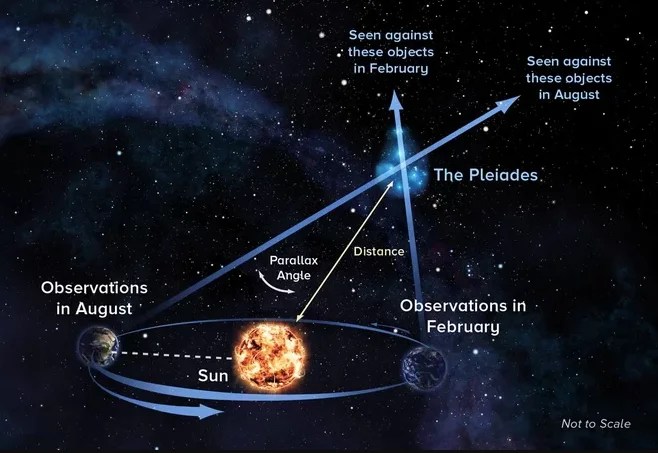
Measurements taken six months apart (when Earth is on opposite sides of the Sun) use the maximum baseline of 2 AU (300 million km). Even for the nearest stars, parallax angles are tiny — Proxima Centauri has a parallax of 0.768 arcseconds.
The Diurnal Parallax
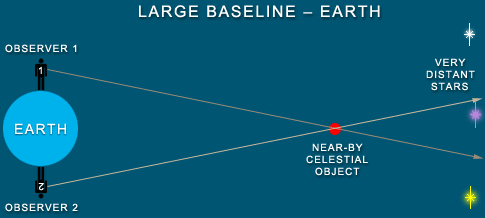
For objects within the solar system — the Moon, nearby asteroids, planets — the baseline of Earth's orbit is too large; we don't need to wait six months. Instead, diurnal parallax uses Earth's own diameter (~12,700 km) as a baseline, observing the object from two widely-separated stations simultaneously.
History of Parallax Measurement
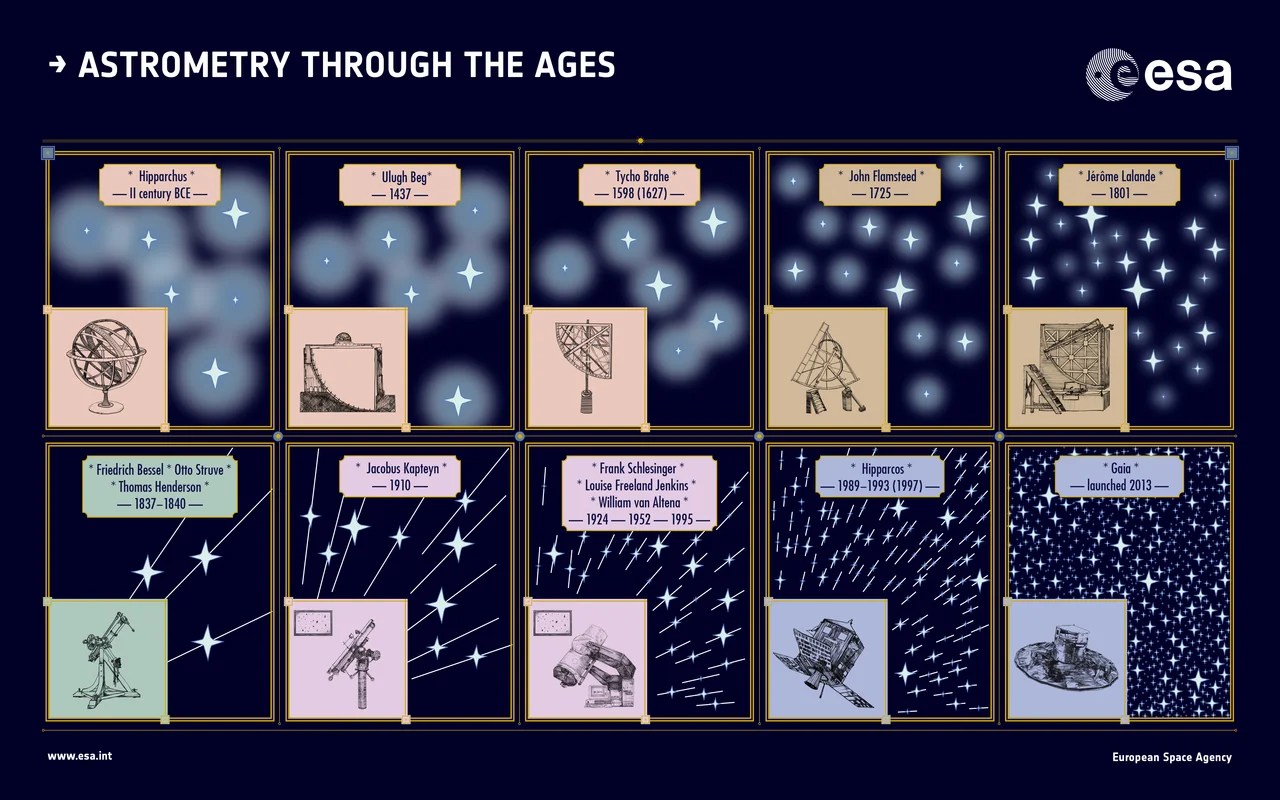
The first successful stellar parallax measurement was made in 1838 by Friedrich Wilhelm Bessel, who measured the parallax of 61 Cygni as 0.314 arcseconds. Before this, the failure to measure parallax was used as evidence against the heliocentric model — critics argued that if Earth moved, nearby stars should visibly shift. When telescopes became precise enough to detect the shift, it confirmed heliocentrism and gave us our first true stellar distances.
Modern Parallax: Hipparcos and Gaia
Ground-based parallax is limited by atmospheric turbulence to angles larger than about 0.01 arcseconds. Space removes this limitation.
ESA's Hipparcos satellite (1989–1993) measured parallax angles as small as 0.002 arcseconds for about 120,000 stars.
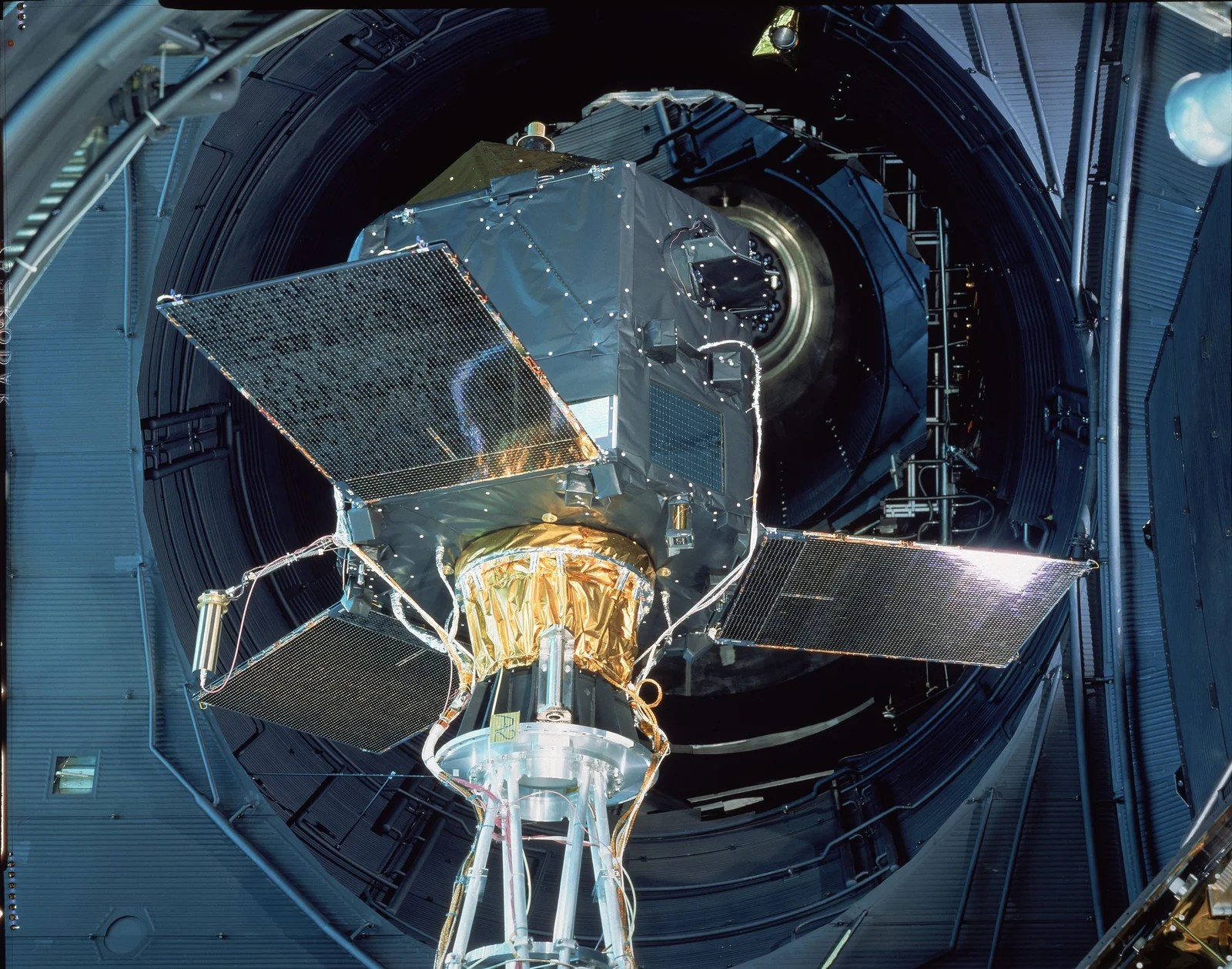
ESA's Gaia mission (launched 2013) has achieved parallax precision of 0.00002 arcseconds for over 1.5 billion stars — reaching distances of several kiloparsecs with useful accuracy. Gaia has transformed stellar astronomy, providing a foundation that improves every higher rung of the distance ladder.
Parallax is reliable to distances of about 1–10 kpc (Gaia-era precision) — covering most of the Milky Way's disk.
Rung 2: Cepheid Variable Stars
Beyond a few kiloparsecs, parallax angles become too small to measure reliably even from space. The next rung relies on a remarkable class of stars that act as standard candles — objects whose intrinsic luminosity is known, so that the apparent brightness tells you the distance.
Cepheid variables are pulsating giant stars that rhythmically expand and contract, brightening and dimming with periods of 1 to 100 days. In 1908, Henrietta Swan Leavitt discovered a tight relationship between a Cepheid's pulsation period and its absolute luminosity: longer period = more luminous, with no scatter.
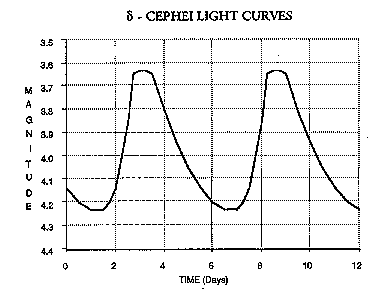
If you observe a Cepheid in a distant galaxy, you measure its period (from the light curve) and apparent magnitude (how bright it looks). The period tells you the absolute magnitude via the period-luminosity relation. The distance modulus formula then gives the distance:
Solving for :
Cepheids calibrated against Gaia parallaxes can reach distances of 30–50 Mpc (megaparsecs) — far enough to reach many galaxy clusters. They were Hubble's primary tool when he discovered the expansion of the universe.
Rung 3: Stellar Spectroscopy and Color
Stars can be classified by their surface temperature, which controls the color of their light. The spectral sequence (O, B, A, F, G, K, M) runs from hottest to coolest, with well-established luminosities for each spectral type on the main sequence.
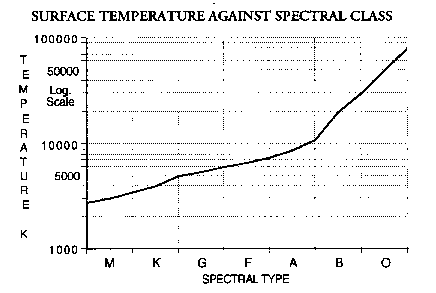
Stefan-Boltzmann's law relates a star's luminosity to its radius and temperature:
By measuring the spectrum (which gives temperature and spectral class) and comparing to standard stellar models, you can estimate . Comparing to the measured apparent brightness gives the distance:
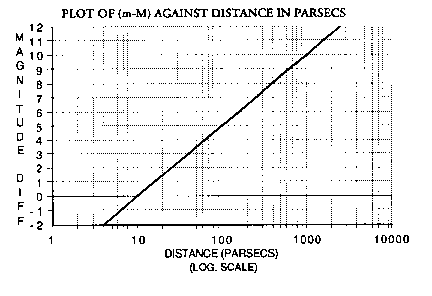
This spectroscopic parallax (misleadingly named — no actual parallax is measured) works for any star whose spectrum can be measured, extending coverage to hundreds of kiloparsecs for bright supergiants.
Rung 4: Type Ia Supernovae
For distances beyond the reach of Cepheids — across hundreds of megaparsecs and into the truly cosmological regime — astronomers use Type Ia supernovae as standard(izable) candles.
Type Ia supernovae occur when a white dwarf in a binary system accretes matter from its companion until it reaches the Chandrasekhar limit (~1.4 solar masses), triggering a thermonuclear explosion. Because the trigger mass is nearly constant, the peak luminosity is nearly constant — about watts, briefly outshining an entire galaxy.
In 1998, two teams using Type Ia supernovae to measure distances at redshifts of discovered that the universe's expansion is accelerating — a result that earned the 2011 Nobel Prize in Physics and led to the concept of dark energy.
Rung 5: Hubble's Law
At the largest scales, recession velocity itself becomes a distance indicator. Edwin Hubble showed in 1929 that galaxies are moving away from us, and that recession velocity is proportional to distance:
where is the Hubble constant (~70 km/s/Mpc). By measuring a galaxy's redshift — the Doppler shift of its spectral lines — and converting to recession velocity, we get the distance.
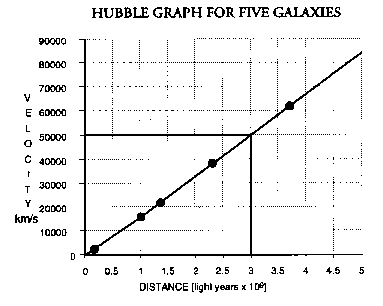
This works for the most distant galaxies observable, up to the edge of the observable universe at ~46 billion light-years (noting that the universe's expansion itself carries distant galaxies beyond simple Doppler recession).
The Distance Ladder at a Glance
| Method | Calibration | Reliable Range |
|---|---|---|
| Parallax (Gaia) | Geometry | Up to ~10 kpc |
| Cepheids | Gaia parallaxes | Up to ~50 Mpc |
| Spectroscopic parallax | Nearby stars | Up to ~1 Mpc |
| Type Ia supernovae | Cepheids | Up to ~1 Gpc |
| Hubble's Law | All of the above | Full observable universe |
The Hubble tension: Different rungs of the distance ladder currently give slightly inconsistent values of . Measurements from the early universe (via the cosmic microwave background) give ~67 km/s/Mpc; measurements from supernovae and Cepheids give ~73 km/s/Mpc. This discrepancy — at the 4–5 sigma level — is one of the most important open problems in cosmology, suggesting either systematic errors in the distance ladder or genuinely new physics.
Explore more simulations
Every concept on PhysicStuff has an interactive simulation. No login, no setup required.