🔭 Astrophysics · 23 November 2017
What Are Shooting Stars?
On a clear night, if you watch the sky long enough, you'll see a streak of light flash across the darkness and vanish in a second or less. We call them shooting stars — but they have nothing to do with stars. They are space rocks burning up in Earth's atmosphere, and the physics behind that brief, brilliant streak is more interesting than most people realize.
The Three Names for One Object
The same rocky object goes by different names depending on where it is:
| Name | Location | Typical Size |
|---|---|---|
| Meteoroid | In outer space | Grain of sand to 1 meter |
| Meteor | Burning in the atmosphere | — (the visible event) |
| Meteorite | On Earth's surface | Whatever survived |
A meteoroid becomes a meteor the moment it enters the atmosphere. If any of it reaches the ground, that surviving fragment is a meteorite. Objects larger than about 10 meters are typically called asteroids instead of meteoroids, though the boundary is informal.
The Physics of Atmospheric Entry
When a meteoroid hits Earth's atmosphere at speeds typically between 11 and 72 km/s, the air in front of it cannot get out of the way fast enough. The molecules pile up in a compressed shockwave directly ahead of the rock. This compression — not friction with the air, as is commonly stated — generates intense heat. The shockwave can reach temperatures of 10,000–20,000 K.
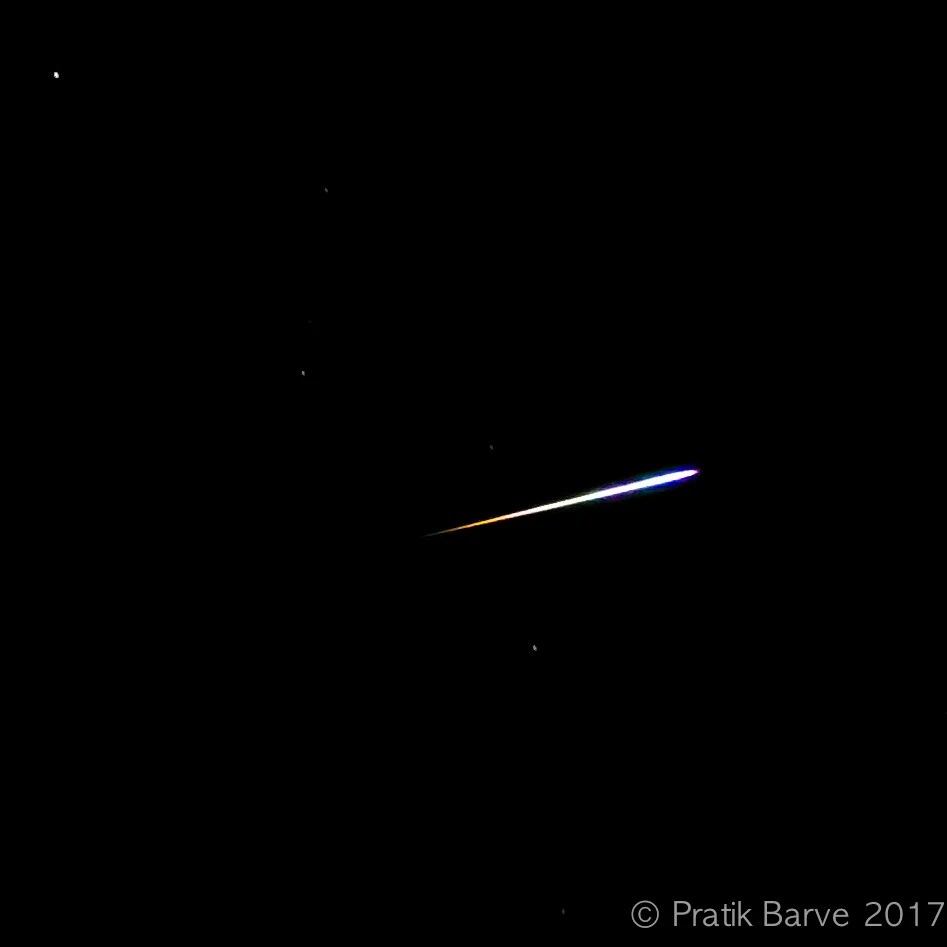
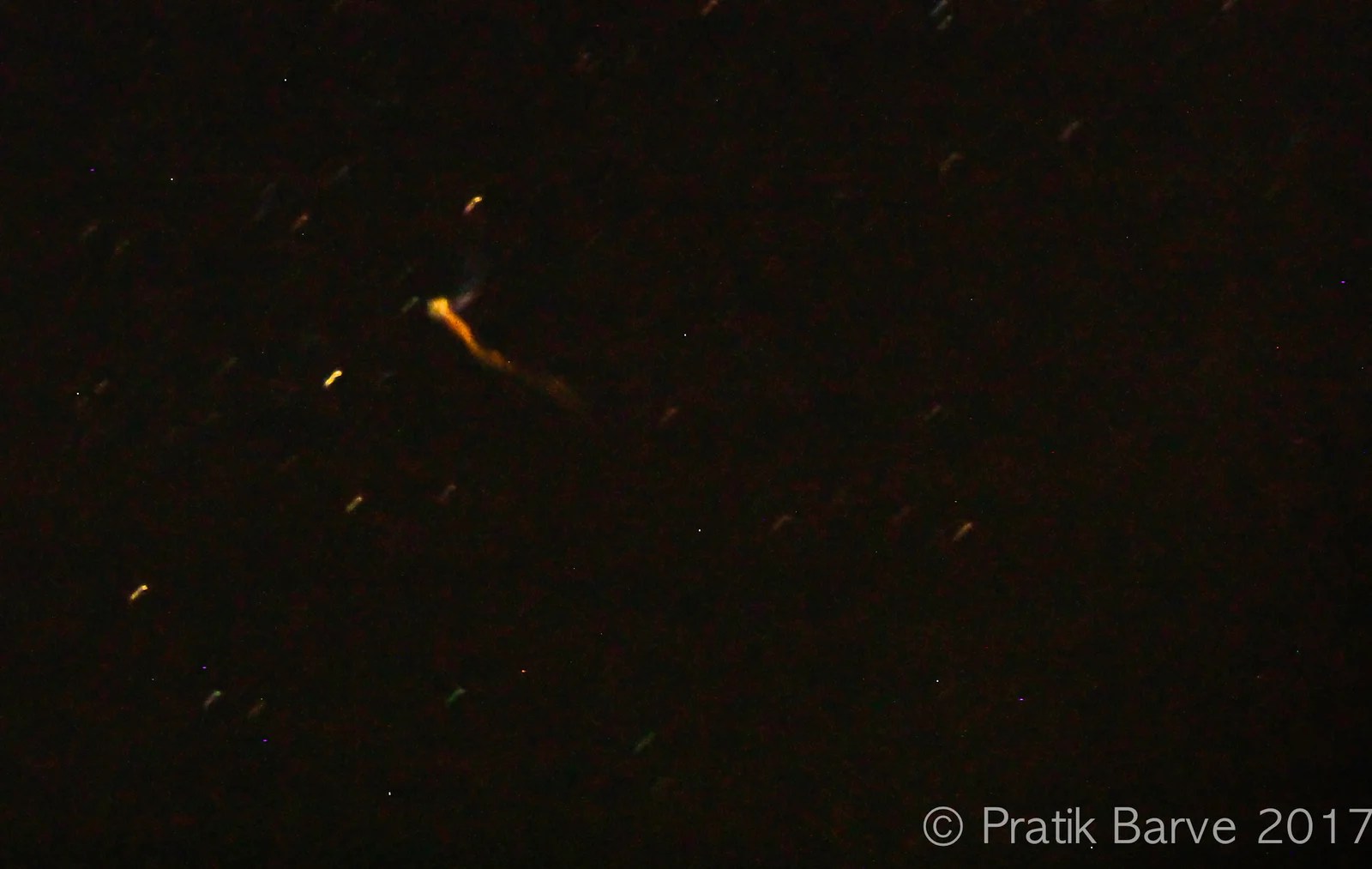
At these temperatures, the surface of the meteoroid melts and vaporizes. Material ablates — it is literally blown away as plasma. This plasma glows brilliantly, producing the streak of light we see from the ground. The trail can persist for seconds or even minutes after the meteor has passed, as excited atoms relax back to lower energy states and emit light.
Why the Colors Tell a Story
The colors in a meteor trail are spectral fingerprints — each element emits light at characteristic wavelengths when its atoms are excited in the plasma:
| Color | Source |
|---|---|
| Orange-yellow | Sodium (Na) |
| Yellow | Iron (Fe) |
| Blue-green | Magnesium (Mg) |
| Violet | Calcium (Ca) |
| Red | Recombining atmospheric nitrogen (N₂) and oxygen (O₂) |
By analyzing the spectrum of a meteor with a prism or diffraction grating, scientists can determine the elemental composition of the original meteoroid — its mineral content and even hints about where in the solar system it formed.
Where Do Meteoroids Come From?
The solar system is full of small debris left over from its formation 4.6 billion years ago. Meteoroids come from several sources:
The Asteroid Belt: The main belt between Mars and Jupiter contains millions of objects. Gravitational interactions — especially with Jupiter — can perturb these objects into Earth-crossing orbits over millions of years.
Cometary Debris: Comets are icy bodies that develop a tail as they approach the Sun. Solar radiation vaporizes the icy surface, releasing embedded dust and rock. This material spreads out along the comet's entire orbit, forming a diffuse stream of debris. When Earth's orbit intersects one of these streams, we get a meteor shower.
Mars and the Moon: Large impacts on these bodies can blast fragments off their surfaces with enough velocity to escape and eventually cross Earth's path. Several meteorites on Earth have been positively identified as pieces of Mars (by matching their trapped gas composition to measurements from Mars landers) and the Moon (by matching their chemistry to Apollo samples).
Ionization Trails

As a meteor blazes through the atmosphere, it leaves a column of ionized air in its wake — a tube of plasma where electrons have been stripped from air molecules by the intense heat. These ionization trails can last from a few seconds to over 30 minutes for especially bright meteors.
Amateur radio operators have long exploited this phenomenon: meteor scatter communications bounce radio signals off these transient ionized columns, allowing communication over distances of 1,000–2,500 km with stations that would otherwise be beyond the horizon. Professional communication systems used this technique operationally from the 1950s through the 1990s.
Meteor Showers
Annual meteor showers occur on predictable dates each year because Earth's orbit intersects the same debris streams at the same times. The shower appears to radiate from a single point in the sky (the radiant), which is simply a perspective effect — parallel trails of meteors, like a car driving into snow, appear to diverge from a single vanishing point.
The Leonid shower (mid-November) is one of the most dramatic. It originates from the debris trail of Comet 55P/Tempel-Tuttle, which has an orbital period of 33.3 years. Each time the comet passes the Sun it leaves a fresh dense trail; when Earth passes through one of these dense clumps (roughly every 33 years), Leonid rates can reach thousands of meteors per hour — a meteor storm.
Major annual showers:
| Shower | Peak Date | Radiant Constellation | Parent Body |
|---|---|---|---|
| Quadrantids | Jan 3–4 | Boötes | Asteroid 2003 EH₁ |
| Perseids | Aug 11–13 | Perseus | Comet 109P/Swift-Tuttle |
| Leonids | Nov 17–18 | Leo | Comet 55P/Tempel-Tuttle |
| Geminids | Dec 13–14 | Gemini | Asteroid 3200 Phaethon |
The Rarest Kind: Meteorite Strikes
Most meteors are smaller than a pea and burn up entirely. Objects larger than a few meters can survive atmospheric entry partially or fully. The 2013 Chelyabinsk event over Russia involved an object about 20 meters in diameter that released energy equivalent to roughly 30 Hiroshima bombs in the atmosphere — its shockwave blew out windows across a wide area and injured over 1,400 people, even though most of it vaporized before reaching the ground.

Ann Hodges holds the dubious distinction of being the only confirmed person in history to have been struck by a meteorite. On November 30, 1954, in Sylacauga, Alabama, a 4-kilogram stony meteorite punched through her roof and ceiling, bounced off a large radio, and struck her on the thigh while she napped. The bruise was spectacular. The meteorite — the Hodges meteorite — is now on display at the Alabama Museum of Natural History.
The sand and rock raining silently into our atmosphere every day — about 40,000–100,000 tons of extraterrestrial material per year, mostly as microscopic dust — is a reminder that Earth's story is inseparable from the rest of the solar system. Every meteor is a message from the early solar system, 4.6 billion years in transit.
Explore more simulations
Every concept on PhysicStuff has an interactive simulation. No login, no setup required.